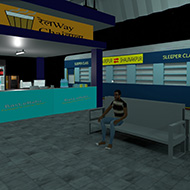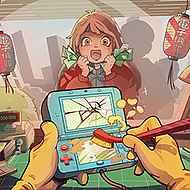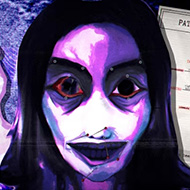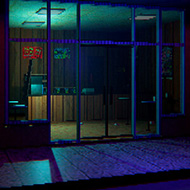








You crouch behind the stall at Fakripur station, chai leaves steeping in the kettle while a train screeches onto the platform outside. Passengers are already crowding the counter, and Ramu doesn’t get a break just because something feels off tonight. Railway Chai Wala drops you straight into that rhythm — pour, serve, repeat — before slowly letting the cracks show underneath it. That contrast between everyday chores and creeping dread is what pulls players in and keeps the game coming up in horror discussions weeks later.
| Genre | Psychological Thriller / Simulation |
| Perspective | First-Person |
| Setting | Fakripur Railway Station |
| Player Mode | Singleplayer |
Ramu’s Shift and the Rhythm of Fakripur Station
Every session of Railway Chai Wala starts the same practical way: you’re Ramu, running a chai stall at a station called Fakripur, and the trains don’t wait for you to catch up. Early on, the loop feels almost meditative. Steam a pot, hand off a cup, take payment, move to the next face in line. Beginners tend to get wrong just how much this game rewards paying attention to small details rather than rushing — fumbling an order or ignoring a passenger’s odd remark can matter later even when nothing seems to happen in the moment.
The station itself does a lot of quiet work here. Platform announcements, the clatter of luggage, and the specific hiss of an arriving train build a sense of place that most short indie games skip entirely.
By the time you’ve served a few rounds of passengers, the pacing settles into something closer to a slow burn than a straightforward horror game, which is exactly the vocabulary players use when they describe it in forums and reviews.
Brewing Chai, Frying Samosas, and Selling Kokila Kola
The actual stall work in Railway Chai Wala covers more than tea. You’re brewing chai and coffee, frying samosas, putting together vada pav, and pouring bottles of Kokila Kola for travelers who are usually in more of a hurry than they let on. None of it is mechanically deep, but that’s not really the point — the simplicity is what lets the game layer unease on top without the systems getting in the way.
Players who come in expecting a management sim with complex resource juggling tend to be the ones most surprised by where things go. Story-focused players, on the other hand, treat the cooking as texture rather than the main event, and that reading fits the game better.
Once you reach the point where regular passengers start repeating themselves or reacting to things that weren’t said out loud, the food service stops being just food service.
Reading Passengers at the Fakripur Counter
A big part of what makes Railway Chai Wala memorable is its cast at the counter. Travelers pass through with quirks, throwaway lines, and occasional behavior that reads as slightly wrong rather than obviously threatening. Detail-oriented players get the most out of this, since a lot of the game’s unease comes from noticing what’s different about a returning face rather than from anything explicitly telegraphed.
Community vocabulary around the game leans on comparisons to Fears to Fathom-style titles — grounded, everyday settings that curdle slowly instead of announcing themselves.
That comparison holds up well once the mystery under Fakripur starts surfacing through the passengers themselves rather than through cutscenes or forced exposition.
Where Railway Chai Wala Turns From Cozy to Unsettling
Early in the game, nothing suggests you’re playing anything other than a warm slice-of-life sim about serving chai. That’s deliberate, and it’s also the aspect players debate most: some find the shift into the darker, mystery-driven back half earns its atmosphere, while others feel the tonal swing arrives faster than the setup prepared them for. Both reactions show up regularly in player discussions, and it’s a fair criticism either way.
Once the station’s secrets start pushing through the daily routine, the stall work you’ve been doing on autopilot suddenly carries weight it didn’t have an hour earlier.
That reframing — turning a familiar loop into something you can’t fully trust — is the strongest trick the game has, and it lands mostly because the opening hours committed so fully to the mundane version of Ramu’s life.
How long does it take to finish Railway Chai Wala?
It’s built to be completed in a single sitting rather than across multiple long sessions, with a runtime that reviewers consistently describe as tight — long enough to land its story about Ramu and Fakripur without padding the stall work out.
Is Railway Chai Wala actually scary or mostly atmosphere?
It leans more on unease and mystery than jump scares, building dread through repeated interactions at the counter and small inconsistencies among the passengers rather than sudden shocks.
Do I need horror game experience to understand Railway Chai Wala?
No — the chai-brewing and serving loop is simple enough for newcomers, and the horror elements are introduced gradually through Ramu’s routine rather than through mechanics that require prior genre knowledge.
- Watch for passengers who reappear with slightly altered dialogue.
- Keep serving Kokila Kola and samosas even when the station feels off — stopping doesn’t skip anything.
- Pay attention to background sound cues near the platform, not just what’s said at the counter.
Railway Chai Wala earns its reputation by trusting a stall, a station, and a chaiwala named Ramu to carry the whole experience without ever needing to explain itself too loudly. Fakripur stays with you precisely because the game never stops being about brewing chai, even after you’ve realized it was never really about that at all.