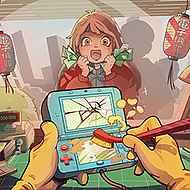








You tap the screen a half-second too late, watch your toaster clip the edge of a rising bar, and spin off the track just as the exit gate flashes into view. That’s the rhythm of Toaster Dash: short bursts of momentum, tight timing windows, and the constant temptation to push one more obstacle than you’re ready for.
| Genre | Browser arcade / endless runner-platformer |
| Controls | Arrow keys (desktop) or tap zones (mobile) |
| Core Ability | Dash boost with cooldown |
| Win Condition | Reach the level exit without losing all lives |
Reading the Toaster Before You Move
The toaster you control doesn’t accelerate the way most platformer characters do. It has weight to it, a slight delay between input and motion, which means Toaster Dash punishes players who mash direction keys instead of committing to a line. Early levels feel forgiving because the obstacle spacing is generous, but that spacing tightens fast, and the same twitch habits that got you through level three will get the toaster clipped by level eight.
New players almost always misuse the dash. It looks like an escape button, something to mash when a spike block appears out of nowhere, but the cooldown means a panic-dash at the wrong moment leaves you with nothing when the real gap shows up two seconds later. The players who progress fastest treat the dash as a scheduled tool, not a reflex, and they tend to call this “banking the dash” in community chats, meaning they hold it in reserve through an easy stretch specifically because they can see a harder cluster coming.
Speed adjustment is the other piece beginners skip entirely. Slowing down before a blind corner costs you almost nothing in Toaster Dash, since the scoring rewards clean runs over reckless ones, but a crash resets your run and your multiplier both. Players coming from twitchier arcade games often fight this instinct for their first ten or so attempts before it starts to feel natural.
Difficulty Curve and the Multiplier Trap
Once you’re past the opening stretch of levels, the game starts layering obstacles instead of spacing them out one at a time. You’ll see a moving bar directly followed by a narrow gap, then a speed-up zone right after, and this is where the score multiplier becomes both a reward and a liability in Toaster Dash.
Casual players tend to ignore the multiplier and just aim to survive. Speedrun-minded players chase it aggressively, which means taking tighter lines through obstacle clusters instead of the safer wide route. Both approaches are valid, but they require different muscle memory, and mixing them mid-run is usually what causes late-level deaths — you commit to a greedy line out of habit, then flinch and slow down halfway through it, which is worse than picking either approach cleanly.
By the time you reach the mid-difficulty levels, the multiplier resets on any missed obstacle rather than any crash, which surprises a lot of players who assumed only a full loss of lives would cost them progress. Once you internalize that rule, route planning changes completely.
- Watch obstacle patterns twice before committing to a route
- Save the dash for compound obstacles, not single spikes
- Adjust speed early, not at the last possible frame
- Treat multiplier resets as a planning cue, not a punishment
Advanced Timing Most Players Never Pick Up
There’s a specific sound cue right before a speed-up zone kicks in, and most casual players never consciously register it even after dozens of runs. Veteran players use that half-second warning to pre-adjust their line before the screen actually speeds up, which is the single biggest separator between mid-level and top-tier scores in Toaster Dash.
Another technique that rarely gets mentioned: holding a slightly slower speed through obstacle clusters instead of full speed makes the dash cooldown effectively shorter relative to how often you need it, since you’re spacing out your dash usage across more real time. It’s a small adjustment, but it noticeably reduces late-run crashes once you’re comfortable enough to try it deliberately instead of defaulting to max speed everywhere.
None of this matters much in the first few levels. It starts mattering once obstacle density crosses a threshold most players hit somewhere around the tenth or eleventh stage, where a single missed adjustment compounds into a crash two obstacles later instead of an immediate one.
What Players Actually Debate
The community split on Toaster Dash mostly comes down to input feel. Some players find the tap-zone mobile controls too imprecise for the later obstacle density, while desktop players with arrow keys report a cleaner, more consistent experience. It’s a fair criticism, and it’s part of why a lot of players default to keyboard once the levels stop being forgiving.
There’s also a smaller but persistent debate about whether the dash cooldown is too punishing relative to how often compound obstacles show up in later levels. Players chasing high multipliers tend to defend the cooldown as the whole point of the challenge, while more casual players see it as the main source of frustration once runs get long.
What is the dash cooldown in Toaster Dash?
The dash has a short recovery window after each use, long enough that spamming it back-to-back through a cluster of obstacles usually fails. Treat it as a single-use tool per obstacle section rather than a repeatable escape.
Why do I keep crashing on the same obstacle?
Most repeated crashes come from adjusting speed too late rather than moving in the wrong direction. Slow down a beat earlier than feels natural, and the same obstacle usually clears.
Does Toaster Dash get harder after the first few levels?
Yes, noticeably. The game moves from single obstacles to stacked combinations somewhere around level ten, and that’s typically where new players hit their first real wall.
Toaster Dash rewards patience dressed up as speed: the fastest clean runs come from players who treat the dash boost like a scarce resource instead of a panic button, and once that clicks, the obstacle clusters that used to end runs early start feeling like just another rhythm to read.