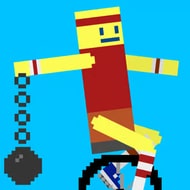








Unicycle Hero looks like a simple balancing game with a bike wheel and a hill, but it plays like a lesson in momentum, and that gap between expectation and reality is what actually hooks people.
Balance as the Real Obstacle
The core mechanic is deceptively small: keep a single wheel upright while riding across uneven ground, ramps, gaps, and loops, using tilt controls to shift your weight forward or back. There is no separate jump button doing the heavy lifting for you, so every obstacle in the game is really a balance problem wearing a different costume. That framing takes a while to sink in, since most players expect a platformer and get a physics puzzle instead.
Beginners almost always overcorrect. They see the unicycle tipping forward and yank the controls hard the other way, which sends it tipping backward instead, and the crash happens in the overcorrection rather than the original tilt. Small, early adjustments beat big, late ones, and that single habit change is usually the difference between finishing a stage and restarting it five times.
The wheel itself has a surprising amount of inertia once you are moving at speed, which means the same tilt input produces a very different result at a crawl versus mid-jump. Learning to read your own current speed before reacting to a bump in the road is something the game never explains directly, but it becomes second nature after a few failed runs.
How the Course Escalates
Early stages in Unicycle Hero are mostly flat ground with the occasional small ramp, just enough to teach the tilt controls without real risk. Once loops and narrow platforms start appearing, the margin for error shrinks fast, and maintaining speed through a loop becomes just as important as staying balanced, since too slow means falling off the top.
Coins scattered along each course are optional, but reaching the ones tucked near gaps or ledges usually means taking a riskier line than the safe route through. Players chasing a full coin collection on a stage tend to play it very differently from players just trying to reach the finish flag, since the safest path and the most rewarding one rarely overlap.
Narrow platforms introduce a different kind of pressure than gaps or loops, because there is very little room for the small side-to-side wobble that is normal on open ground. A wobble that would be harmless on a wide path is often enough to send you off the edge on these sections, which is where a lot of players report losing the most attempts.
Momentum Is the Advanced Technique
Most players eventually stop thinking about individual obstacles and start thinking about a whole stretch of a stage as one continuous balance problem. Carried momentum is the term that describes riding into a jump or gap with speed built up from the section before it rather than stopping and restarting, and it is what separates players who clear a stage smoothly from players who limp through it one obstacle at a time.
Losing that momentum on a checkpoint restart is one of the more frustrating moments the game produces, and it is a fair complaint players raise often — a single mistimed landing can cost you a run that was otherwise going well, forcing a rebuild of speed through an entire earlier section just to attempt the same jump again.
Players who focus on speedrunning a stage tend to memorize exactly where to start braking before a loop, while players just trying to survive a course for the first time usually play far more cautiously, tapping the brakes constantly rather than trusting the momentum they have already built.
Reading the Ground Ahead
One detail players notice only after a fair number of runs is the slight change in surface texture right before a hidden dip in certain stages, a small visual cue that experienced players use to start adjusting their weight a half-second early. It is not explained anywhere in the game itself, which is exactly the kind of detail that turns into shared knowledge on forums rather than something everyone discovers alone.
By the time you reach the loop-heavy later stages, Unicycle Hero has quietly taught you an entirely different way of reading a course, one where the wheel underneath you matters more than whatever obstacle is coming next.
Frequently Asked Questions
What happens if I fall mid-air instead of on the ground?
The unicycle simply resets to the last checkpoint rather than punishing you further, so aggressive attempts at tricky gaps carry less long-term risk than they first appear to.
Does tilting harder always mean turning or leaning faster?
No. Past a certain point, extra tilt just increases the chance of a fall rather than adding speed to the correction, which is why small adjustments tend to outperform sharp ones.
Do I need to collect every coin to finish a stage?
No, coins affect scoring rather than completion, so a player focused purely on reaching the finish flag can skip risky detours entirely.
Between the overcorrection traps early on and the carried momentum that later stages demand, Unicycle Hero turns a single wobbling wheel into a genuinely deep balance game, and clearing a loop clean on the first try still feels earned every time.