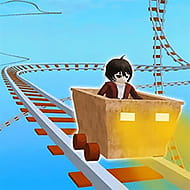








You ease off the throttle a half-second too late as the track drops away beneath you, and for one long moment your cart is airborne over open sky with no rail underneath it at all. That’s the exact moment Rail in the Air is built around, and it happens to nearly every player on their very first run.
| Genre | Simulation / Skill |
| Setting | Suspended sky tracks |
| Platform | Browser |
| Controls | Throttle, Brake, Dashboard, Respawn |
| Structure | Stage-based routes |
What Rail in the Air Is Actually Asking You to Do
Strip away the sky-high setting and Rail in the Air is a momentum management game wearing a train simulator’s clothes. You’re driving a wooden rail cart along narrow tracks suspended over open air, with no guardrails and no room for correction once you’ve committed to a curve. There’s no combat, no enemies, and no dialogue-driven story here — the entire game is you, the cart, and a track that gets less forgiving the further you go.
The structure is stage-based rather than one continuous run. Each stage is its own route with its own rail layout, and clearing one unlocks the next. Early stages are deliberately gentle, mostly there to teach you how the cart accelerates and decelerates before the track design starts punishing hesitation and overconfidence in equal measure.
What makes this loop stick is how directly every mistake maps back to a decision you made a few seconds earlier. There’s no random element throwing off a clean run — if you go off the rails, it’s because of a specific throttle or brake input, and that clarity is a big part of why players keep going back for another attempt.
Throttle, Brake, and the Physics Underneath
Acceleration is handled with W or the up arrow, and braking with S or the down arrow, but treating these like a normal driving game’s gas and brake pedals is the fastest way to lose your cart. Holding the throttle down on a downhill stretch doesn’t just speed you up — gravity stacks on top of your own acceleration, and the combined momentum can be enough to tear the cart off the rails entirely on the next sharp turn.
Braking works the same way in reverse. Tapping S creates friction against the wheels rather than slamming the cart to an instant stop, which matters because a full stop mid-track, especially on an incline, can leave you without enough inertia to carry over the next rise. You end up stuck, rolling backward, with the only real fix being a full respawn.
This tension between building enough speed to survive an uphill stretch and not building so much that you can’t control a downhill one is the entire skill curve of Rail in the Air. It’s a small set of rules, but the interaction between them gets genuinely complex once tracks start twisting through multiple elevation changes back to back.
Reading a Track Before You Reach It
Because there’s no way to correct a bad entry into a sharp curve once you’re already committed, the players who improve fastest are the ones who train themselves to look ahead of the cart rather than at it. Watching the horizon for upcoming slopes and turns lets you start adjusting speed well before the danger zone rather than reacting once you’re already in it.
This is where Rail in the Air quietly separates itself from a normal skill or reflex game. Success doesn’t come from having the fastest fingers on the keyboard — it comes from recognizing a pattern in the track layout early enough to already be at the right speed when you reach it. Players coming from rhythm games or precision platformers tend to pick this habit up quickly, since it’s the same kind of pattern-reading those genres already demand.
The Dashboard and Respawn Loop
Pressing C opens the cart’s technical dashboard, giving you a readout of your current performance and an early warning on developing instability before it turns into a full derailment. It’s easy to ignore this entirely on early stages, since the margin for error is generous enough that you rarely need it, but on later routes checking the dashboard before a difficult stretch becomes a genuine habit for players trying to clear a stage cleanly.
Falling off the track doesn’t mean starting the whole stage over from the very beginning. The R key triggers an instant respawn, putting the cart back on the rails near where it fell rather than forcing a long reload. This respawn loop is core to how the game teaches you — you’re expected to fail repeatedly on a tricky curve, and the fast reset keeps that failure from feeling like a punishment so much as a quick second attempt.
- W / Up Arrow — throttle, builds forward momentum
- S / Down Arrow — brake, applies wheel friction
- C — opens the technical dashboard
- R — instant respawn after falling
Common Mistakes on Early Stages
New players almost universally over-brake on their first few downhill sections, coming to a near-stop out of caution and then getting stuck without enough inertia to clear the next rise. It feels counterintuitive at first, since braking is usually the “safe” choice in most games, but Rail in the Air specifically punishes excessive caution nearly as often as it punishes recklessness.
The second common mistake is holding the throttle continuously instead of applying it in short, deliberate bursts. Full acceleration held down through a curve is almost always what sends a cart flying off the rails, especially once a stage introduces its first genuinely tight spiral turn.
Players used to arcade-style racers tend to struggle here specifically, since Rail in the Air rewards restraint over the flat-out speed those games usually favor. Adjusting that instinct is often the single biggest jump in performance between a player’s first attempt at a stage and their fifth.
Why Later Stages Feel Like a Different Game
Once you’re several stages in, the track design stops giving you long straight stretches to recover between mistakes. Turns start chaining together, elevation changes happen with almost no warning, and the window to correct your speed before a curve shrinks to almost nothing. By the time you reach the stages with genuine spiral sections, the game has effectively stopped being about learning the controls and started being about memorizing the specific rhythm of that individual route.
This is also where the respawn loop starts feeling less like a safety net and more like the actual gameplay. Clearing a difficult stage in Rail in the Air often looks less like one clean successful run and more like a dozen short attempts, each one carrying a little more information about exactly where the track turns hostile.
What Players Find Divisive About Rail in the Air
The lack of any story, named characters, or mission structure is the most commonly debated aspect of the game in player discussion. Some players appreciate how purely mechanical the experience stays, with nothing distracting from the momentum and balance systems at its core. Others find the complete absence of narrative context makes long sessions feel repetitive once the novelty of the sky-track setting wears off, since stage after stage is fundamentally the same throttle-and-brake challenge with a new layout.
It’s a fair criticism either way you land on it — Rail in the Air was clearly built as a tight mechanical challenge first, and anyone expecting a broader game around that mechanic is going to come away wanting more than the game is trying to offer.
What are the controls in Rail in the Air?
Throttle is W or the up arrow, brake is S or the down arrow, C opens the technical dashboard, and R triggers an instant respawn after falling off the track.
Why does my cart keep flying off the rails on downhill sections?
Holding the throttle on a downhill stretch stacks your own acceleration on top of gravity’s pull, building more momentum than a sharp curve can handle. Tapping the brake early, before the curve rather than during it, is the fix most players eventually settle on.
Do I have to restart the whole stage after falling off the track?
No — the R key respawns your cart quickly near where it fell, rather than sending you back to the very start of the stage, which is what makes repeated attempts on a difficult curve practical instead of tedious.
Rail in the Air never dresses up what it’s asking of you — it’s just a cart, a throttle, a brake, and a rail system that punishes hesitation and recklessness in exactly equal measure, and clearing one of its later spiral stages without a single respawn is as close as this game gets to a real finish line.