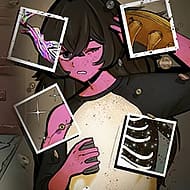








You’ve been camped on the same stretch of curb for what feels like forever, watching strangers pass without so much as a glance, when a coin finally lands near your knee. That single moment — begging, waiting, hoping someone drops something — is the entire rhythm that opens Interdimensional Vending Machine, a survival game built around one object that has no business existing: a vending machine that eats yen and dispenses food that defies biology.
| Genre | 2D survival horror with interactive fiction elements |
| Setting | A distorted city centered on Empty Street |
| Protagonist | Aster, a homeless girl |
| Core Currency | Japanese yen coins |
| Known Endings | Apple Seed, Bride, Police, Starvation |
Coins, Yen, and the Rules Behind Interdimensional Vending Machine
The loop sounds simple on paper: sit on the street, collect yen from passersby who might drop a coin, say something cruel, or say nothing at all, then carry that yen to the machine. Inserting it triggers a random dispense, and the amount you feed in actually matters, since different yen values are tied to different pools of items behind the scenes. Some coins return ordinary-looking snacks, others return something that used to be alive, and the game gives you almost no warning about which is coming.
One quirk players discovered early is that certain purchases cause a number to flash briefly on the machine’s screen right after the item drops. Feeding that exact yen amount back in tends to reproduce the same item, which is how the community started trading informal lists of coin codes. It’s also why jokes about specific yen amounts, like 69 or 420, circulate constantly in comment sections, even though the machine treats those numbers no differently than any other combination.
There’s also a well-known coin duplication trick involving dropping and re-picking-up a placed coin outside the slot, though most players treat it as an exploit rather than an intended shortcut.
- Food — restores hunger, ranges from mundane to unsettling
- Drinks — restore thirst but stack toward specific transformation routes
- Seeds — rare, tied directly to one of the game’s mutation paths
The Apple Seed Route and Other Mutation Paths
Feeding Aster Apple Seeds consistently, usually pulled from 1, 5, 10, and 50 yen inserts, pushes her through five distinct transformation stages. By the time she clears the fifth stage, her hair has turned glowing white, extra arms have sprouted from her back, and she reads less like a starving girl than something that crawled out of a different reality entirely — it’s the kind of visual payoff long-time players screenshot for the still-unreliable gallery feature.
The Bride path works almost in reverse: hoard drinks instead of using them immediately, then dump the whole stockpile into Aster at once. Her stomach bloats progressively while her neck and lips shrivel, ending in a hollow-mouthed, fluid-seeping shape that looks nothing like the apple seed transformation. A separate route built around Human Flesh items — blood, hair, eyeballs, roughly 45 of them collected before feeding — produces a twisted, multi-eyed creature instead, which tells you how differently the same core loop can end depending on what you choose to feed her.
Hunger, Idle Time, and What Interdimensional Vending Machine Doesn’t Explain
The most common complaint in player discussions isn’t the horror content, it’s the pacing. Hunger drains fast enough that experimenting with different items feels risky rather than fun, and long stretches of waiting for coins on the street can feel closer to an idle game than an active one. Idle-game regulars tend to tolerate this fine, watching numbers tick up while they multitask, but players who came in expecting constant new content from the horror tag often burn out before reaching a real ending.
Easy mode adds its own confusion. Several players have reported Aster failing to starve at all on that setting, which suggests the hunger drain is scaled down further than intended rather than acting as a true safety net.
Endings the Community Actually Reaches
Camping the same spot on Empty Street for too long while collecting coins eventually draws the police, ending the run outright. Refusing to eat anything at all does the opposite, leaving Aster to starve into a skeletal, hollow-eyed shape instead. Both are treated as confirmed stopping points, unlike some of the mutation routes, which players still debate the exact requirements for.
The gallery meant to track which items and endings you’ve unlocked has been unreliable for a lot of players, which is a fair thing to call out given how much of the appeal depends on comparing notes with other people chasing different outcomes. Completionists tend to forgive it because the underlying mutation system is unusual enough to be worth the frustration.
Whether you’re farming coin codes toward the Apple Seed ending or just curious how far Aster can drift from human before the police show up, Interdimensional Vending Machine keeps its loop small enough that one more coin always feels worth trying.