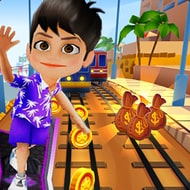








You’re three trains deep into a run with no end screen in sight, coins ticking up in the corner, and one badly timed dodge is about to reset everything back to zero. That’s the entire tension of Subway Runner distilled into a single moment, and it’s exactly why a game with almost no extra systems still manages to hold your attention for run after run.
| Genre | Endless Runner |
| Platforms | Browser (HTML5) |
| Goal | Dodge trains, collect coins |
| Session length | Under a minute per run |
Dodging Trains Without Any Room for Error
The core loop in Subway Runner is deliberately narrow: trains come at you, and touching one ends the run instantly. There’s no health bar, no shield, and no second chance, which means every dodge carries the same weight whether it’s your first train or your fiftieth. The game never explains this beyond the initial prompt, and it doesn’t need to.
This is where the game earns the label “unforgiving” from players in the community. A single mistimed move at low speed feels careless, but the same mistake ten trains in feels like a genuine gut punch, since you’ve built real momentum toward a high score by that point. There’s no partial penalty system softening the blow either way.
Players often develop a personal rhythm for reading incoming trains rather than reacting to each one individually. Watching the gap between tracks rather than the train itself is a habit almost every regular player picks up eventually, even if the game never tells you to look for it.
The speed of incoming trains isn’t constant. It creeps upward the longer a run continues, and the shift is gradual enough that most players don’t consciously notice it until they’re suddenly reacting on instinct rather than thought.
Collecting Coins Without Slowing Down
Coins are scattered along the same lanes the trains occupy, which forces a constant tradeoff between greedy collection and safe positioning. Grabbing every coin in sight sounds appealing until a train appears in the exact lane you committed to, and by then it’s too late to correct course.
Early in the game the coin placement feels generous and forgiving. By the time your run has gone on for a while, coins start appearing in tighter clusters right alongside train lanes, and that’s usually the point where a run ends. The temptation to grab “just one more” coin is a well-known trap among regular players.
Some players ignore coins almost entirely and focus purely on survival, treating any coin near a train as not worth the risk. Others chase every coin on screen and accept shorter runs as the cost of a higher immediate score, which splits the community roughly down the middle.
Neither approach is objectively correct. A cautious run that lasts twice as long can still lose to a reckless one that grabs coins aggressively for thirty seconds before crashing.
Chasing a High Score With No Safety Net
Because Subway Runner has no checkpoints or continues, every attempt to beat a personal high score starts from zero. That’s a deliberate design choice that keeps the game feeling tense rather than routine, but it’s also the aspect players most often bring up as a limitation when comparing it to bigger runner games.
A near miss, dodging a train with barely a frame to spare, is the moment players talk about most when describing a good run. It’s a small thing, but it’s the one recognizable high point in an otherwise simple game, and it’s usually what gets screenshotted or mentioned in comments.
The lack of power-ups or variety is a fair criticism. Subway Runner doesn’t pretend to offer deep systems, and some players wish there were more to the game beyond trains and coins, even as others appreciate exactly how stripped-down it is.
Why Simplicity Is the Whole Point
Compared to bigger endless runners with characters, missions, and currency shops, Subway Runner strips everything down to two elements you have to track at once. That simplicity is intentional, and it means the entire skill ceiling comes from reading trains and coins together rather than managing a pile of separate systems.
It’s also why the game works so well for short sessions. A single run rarely lasts more than a minute, which makes Subway Runner easy to pick up for a quick attempt at beating your own score without any real commitment.
How Do You Get a Higher Score in Subway Runner?
Consistency matters more than aggression. Staying in a lane with a clear path rather than weaving for every coin tends to produce longer runs, and longer runs are what actually drive your score up over time.
What Happens If a Train Hits You in Subway Runner?
The run ends immediately with no warning buffer. There’s no partial damage system, so every train is treated the same regardless of speed or position.
Are There Power-Ups in Subway Runner?
No, the game keeps its systems limited to trains and coins. That simplicity is part of the appeal for some players and the biggest missed opportunity for others.
Subway Runner doesn’t dress up its core idea with extra mechanics, and that bare-bones approach is exactly what makes a clean dodge past a train feel satisfying every single time. Whether you’re chasing coins or just trying to survive one more stretch of trains, the game’s simplicity is the whole point rather than something it’s missing.