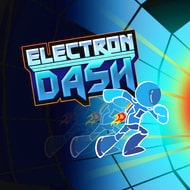








The Core in Electron Dash does not slow down for you, and it does not care which lane looks safer — it only cares whether your charge matches the gate coming up next.
| Genre | Endless Runner / Reflex |
| Platform | Browser |
| Core Mechanic | Switch polarity to pass through matching colored gates while dodging obstacles at increasing speed |
| Controls | Lane switching plus a Polarity Shift input |
The premise of Electron Dash is easy to explain and hard to master: you control the Core, a small charged particle racing forward automatically, and your only real job is reacting fast enough to whatever the track throws at you. Gates appear in either red or blue, matching positive or negative charge, and hitting a gate that does not match your current Polarity Shift ends the run instantly. There is no partial success here — either your charge lines up or it does not.
New players almost always die from hesitation rather than wrong timing. They see a gate coming, start to switch polarity, second-guess themselves, and end up crashing into a color they were about to correctly match a half-second later. The game rewards committing to a read the instant you see it, not deliberating over it.
Reading Gates Before They Arrive
Gate patterns in Electron Dash get denser the further you run, and by the mid-stretch of a typical run you are seeing alternating colors close enough together that a single missed switch chains straight into the next one. Recognizing color clusters rather than individual gates becomes the real skill, since reacting one gate at a time simply is not fast enough once speed climbs.
Obstacle placement adds a second layer on top of the polarity puzzle. Spikes and barriers force lane changes at the same moment a gate demands a Polarity Shift, so late runs regularly ask you to do both at once. Players who separate these into two mental steps tend to fall behind players who treat a lane change and a shift as one combined motion.
Where the Pace Actually Breaks People
Speed increases in Electron Dash are gradual at first and then noticeably sharper once you clear the early checkpoints, which is the point where most casual runs end. The jump in speed is one of the more debated parts of the game — some players find it fair since it forces improvement, others feel it escalates faster than the reaction window can reasonably keep up with.
Score chasers tend to play risky, holding a lane as long as possible for bonus multipliers before switching. Players just trying to survive longer usually shift early and conservatively, giving up a bit of score for a cleaner run. Both playstyles show up constantly in community high-score threads.
- Polarity Shift must match the gate color exactly or the run ends
- Obstacle and gate timing overlap increases significantly past the early checkpoints
- Score multipliers reward holding a lane, at the cost of reaction time later
- Watch for color clusters rather than single gates once speed picks up
- Treat a lane change and a polarity shift as one motion, not two separate reactions
What the Community Argues About Most
The difficulty curve is the single most discussed topic around Electron Dash, and it is a fair criticism to raise — a run that feels manageable for the first stretch can turn punishing quickly, and not every player agrees that the escalation is well paced.
Frequently Asked Questions
Why does switching polarity early sometimes still fail?
Because the shift has a brief input window, and switching too early before a gate is close enough can leave you back on the wrong color by the time you actually reach it, especially at higher speeds where positioning shifts fast.
Is there a way to recover after hitting the wrong gate?
No, hitting a mismatched gate in Electron Dash ends the run immediately, which is why conservative players shift as soon as a gate is visible rather than waiting for a perfect read.
Does obstacle difficulty scale separately from gate frequency?
Yes, obstacles and gate density increase somewhat independently, which is exactly why the mid-to-late stretch of a run feels harder than earlier speed alone would suggest.
Electron Dash turns a simple red-or-blue decision into a full reflex test, and once the Core starts weaving through overlapping gates and spikes at full speed, every run stops feeling like a runner and starts feeling like a rhythm test with no music.