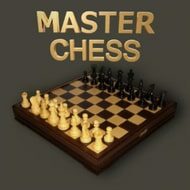








Turns are timed in Master Chess, which is the one detail that changes everything about how the game feels compared to a slow, unhurried match over a physical board. You’re not just solving the position — you’re solving it against a clock, and that pressure changes which moves actually get played.
| Genre | Browser chess game |
| Modes | Same-device 1-on-1, online opponent, AI opponent |
| Difficulty settings | Three AI difficulty levels |
| Core mechanic | Standard chess rules with timed turns and highlighted legal moves |
Three Ways to Play Master Chess
Master Chess gives you a same-device mode for passing the board back and forth with a friend, an online mode that matches you against another player, and an AI mode with three difficulty settings for practicing without the stakes of a real opponent. Each mode uses the same core ruleset, so skills built in one carry directly into the others — there’s no separate simplified version hiding behind the practice option.
Most players start on the easiest AI setting to relearn piece movement and tactics before risking a timed online match, and that’s exactly the order the game seems designed to encourage.
Timed Turns and Why They Change Everything
Unlike casual over-the-board chess, Master Chess puts a clock on every turn, which means a beautiful multi-move combination is worthless if you can’t calculate it fast enough to play it. This is the single biggest adjustment for players coming from untimed chess apps — the game rewards pattern recognition over deep calculation, since you simply don’t have time to brute-force every branch.
The legal-move highlighting helps here. Selecting a piece shows every square it can legally reach, which speeds up the mechanical part of finding a move so more of your clock goes toward actual strategy rather than double-checking whether a knight can jump over that pawn.
- Highlighted legal moves remove basic rule confusion, letting the clock pressure focus purely on tactics
- Piece movement follows standard rules exactly — no custom variants or altered piece behavior
- Checkmate ends the game the same way it would over a physical board
Common Opening Mistakes in Master Chess
New players tend to move pawns aimlessly in the opening, chasing small material gains instead of developing the knight and bishop pieces that actually control the center of the board. Against the AI’s easier settings this barely matters, but online opponents punish slow development immediately, often castling early and pressuring an underdeveloped position within the first dozen moves.
The queen coming out too early is another recurring habit. It looks aggressive, but a queen chased around the board by minor pieces loses tempo fast, and tempo is the resource the timer makes most valuable.
Rushed clock management costs more games than actual tactical blunders once you’re past the beginner AI tier.
How the AI Difficulty Actually Scales
The jump between the three AI difficulty settings in Master Chess isn’t just “plays better moves” — the higher tiers punish positional weaknesses that the lower tiers ignore entirely, like a weak back rank or an undefended rook left on an open file. Players who’ve only faced the easiest setting are often surprised by how quickly the middle tier finds tactics they didn’t see coming.
By the time you’re consistently beating the hardest AI setting, online matches against real players start feeling more manageable, since human opponents at a casual level tend to make similar categories of mistakes.
What Online Opponents Do Differently
Online play in Master Chess strips away the predictability of AI patterns. Real opponents bluff with piece sacrifices, play openings the AI never uses, and adjust their pace under time pressure in ways that are much harder to prepare for. It’s a genuinely different experience from AI mode, and it’s usually where players find out whether their opening theory actually holds up under a countdown.
Is Master Chess good for learning real chess strategy?
Yes, since it follows standard rules for every piece and win condition — the clock is the only major departure from traditional over-the-board play, and even that mirrors how competitive chess is often played.
Can I play Master Chess without a timer?
The timed structure is built into the online and AI modes as a core part of the format, so if you want an untimed game, the same-device mode with a friend is the closest option since pacing there is entirely up to the two of you.
Which AI difficulty should beginners start on?
The easiest of the three settings, since it gives enough room to relearn piece coordination and basic tactics before the clock pressure of online matches becomes the main challenge.
Master Chess doesn’t reinvent the rules of the game so much as it sharpens the pressure around them — checkmating a real opponent with seconds left on the clock hits differently than doing it over a relaxed board, and that timer is what keeps players coming back for another match.