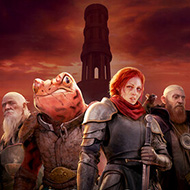








In Songs of Conquest you start with a single Wielder and a modest home settlement, and that early scarcity shapes almost everything that follows — which faction you picked, which Essence types your Wielder can draw on, and how aggressively you can afford to explore before your economy catches up. It’s a slower, more deliberate opening than most modern strategy games attempt, and that’s very much the point.
| Genre | Turn-Based Strategy |
| Perspective | Top-Down Isometric |
| Player Mode | Singleplayer Campaign, Skirmish, and Multiplayer |
| Core Loop | Explore, Build, Battle |
Wielders as the Heart of Songs of Conquest
Every army in Songs of Conquest is led by a Wielder — a magician-commander who levels up individually alongside the troops and buildings under their control. In combat, Wielders channel a resource called Essence to combine their own abilities with those of their army and unlock spells that can swing an otherwise even fight.
Beginners often treat their starting Wielder as interchangeable with any other hero unit, which undersells how specialized they actually are. Lady Hammond, for instance, specializes in Human troops within the Arleon faction, while Gnaw leans into Faey units instead — starting with one over the other meaningfully changes which part of your army you should be recruiting first.
Leveling a Wielder means choosing between upgrading a known skill, learning a new one, or expanding how many troop slots they can command, and those choices compound quickly once a campaign stretches past the opening turns.
Essence, Order, and Chaos: Reading Faction Identity
Essence is the resource that powers spellcasting in Songs of Conquest, and each faction is built around a distinct slice of it. Arleon, the knightly faction blending Humans and the Faey, focuses on Order, Chaos, and Creation — with its Faey units leaning into Chaos and its Shield of Order troops built explicitly around the Order side of that split.
That specialization isn’t just flavor text. A faction locked into three Essence types plays very differently from one that isn’t, which is exactly what separates the base factions from something like the upcoming Roots faction, described as drawing from the full spectrum of Essence rather than being limited to a fixed set.
Understanding a faction’s Essence lean early is one of the fastest ways to avoid building an army that can’t actually cast the spells its own Wielders are trying to reach for.
Minstrels, Footmen, and Arleon’s Support Structure
Arleon is frequently recommended as the entry point into Songs of Conquest, and its Minstrel unit is a good example of why the faction rewards careful positioning rather than pure aggression. Minstrels generate Creation Essence and use it to cast defensive spells like Clouded Vision, which neutralizes enemy ranged troops, and Earth Block, which shores up an army’s flanks.
Footmen benefit directly from Minstrel songs, and since Footmen are the backbone keeping the rest of an Arleon army alive, that support relationship matters more than the flashier ranged options might suggest at a glance.
Arleon’s archers get most of the early attention from new players, but veterans consistently point out that the faction’s high skill ceiling comes from layering support effects like these underneath the ranged damage, not from the ranged damage alone.
Barya’s Gunpowder Economy and Early Aggression
Barya plays almost like the opposite of Arleon’s patient support structure. Built around Order Essence generation and a merchant-nation identity centered on gold and mechanical ingenuity, Barya leans on units like the Dreaths to neutralize enemies quickly and translate that early aggression into rapid territorial control.
Economy-focused players tend to gravitate toward Barya specifically because its explosive early game lets it outpace slower-building factions before they’ve finished setting up their own Essence engines.
That said, leaning too hard into early aggression without banking enough Order Essence for mid-game spellcasting is a common mistake — Barya’s strength is speed, not raw magical depth, and treating it otherwise tends to stall a run out.
Vanir, Shifting, and the Bleak East
Vanir, added as the game’s first DLC faction, brings a Viking-inspired identity to the Bleak East, complete with shifters as a core part of its unit roster. Crones and Nornors stand out here for their shifting ability, transforming into a flock of ravens that can strike any enemy in combat before retreating to their original position.
Nornor’s version of this shift specifically allows an attack without drawing retaliation, which is the kind of detail that separates Vanir’s playstyle from the more conventional melee-and-ranged structure other factions rely on.
Players who enjoy repositioning tricks and hit-and-run tactics tend to find Vanir the most rewarding faction to master, precisely because its signature mechanic punishes opponents who expect standard combat rules to apply.
Toxicologists, Banes, and Mobile Units on the Battlefield
Songs of Conquest’s combat rewards understanding traits like Mobile, which lets units such as Toxicologists and Banes move and fire on enemies without the usual penalty for shooting after moving. That same trait also lets them ignore an enemy’s zone of control, letting them retreat out of melee range without being punished for it.
Militias and Sappers can eventually learn Mobile through research, which turns what starts as a faction-specific advantage into something achievable more broadly with enough investment.
Recognizing which enemy units carry Mobile before committing to an attack is one of the more overlooked tactical reads in Songs of Conquest, and missing it is a common way experienced players still lose units they shouldn’t have.
Building an Economy Around Your Town
Outside of combat, Songs of Conquest expects players to manage resources, research advancements, and shape a town layout that matches how they intend to fight. That planning stage is where a lot of long-term strategy actually gets decided, well before armies ever meet on a battlefield.
Players who rush combat without investing in their town’s growth tend to hit a wall once opposing Wielders start outleveling their own, since troop tiers and available spells both scale directly off town development.
It’s a slower rhythm than most turn-based strategy games ask for, closer in spirit to the 90s strategy classics the game openly draws inspiration from than to faster modern alternatives.
How many factions does Songs of Conquest have?
The base game shipped with four playable factions, and Vanir arrived as the first DLC faction in December 2024, bringing the total to five, with additional factions like Roots planned for future release.
Which faction is best for players new to Songs of Conquest?
Arleon is generally recommended as the beginner-friendly option — its knightly Human and Faey combination is straightforward to pick up, though its narrow spell selection and reliance on ranged units still leave plenty of room to master over time.
What happens if my main Wielder is defeated in a Songs of Conquest campaign?
While the game has mechanics for Wielders to be revived after defeat in other circumstances, campaigns end in an immediate loss if your primary hero is the one who falls, which makes protecting that unit a constant priority rather than a background concern.
- Match your starting Wielder’s specialization — Human, Faey, or otherwise — to the troops you plan to recruit first.
- Track your faction’s Essence types before committing to a spell-heavy strategy that assumes access you don’t actually have.
- Watch for the Mobile trait on enemy units like Toxicologists or Banes before engaging them at range.
Songs of Conquest asks players to treat town-building, Essence management, and Wielder growth as equally important to the battles themselves, and that balance is exactly what gives factions like Arleon, Barya, and Vanir such different personalities in practice. Losing a Wielder can end a campaign outright, which keeps every decision on Aerbor’s battlefields feeling like it actually matters.