







You load up Muse Dash 2 for the first time expecting more of the same two-lane rhythm running, and mostly you get exactly that — Rin, Buro, and Marija are all back, and the core act of striking enemies on beat while dodging between lanes hasn’t been reinvented. What’s different sits around that familiar loop rather than inside it, and that’s the right way to think about this sequel going in.
What Carries Over From the Original Into Muse Dash 2
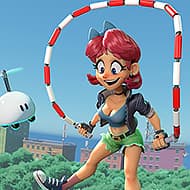
The returning trio is the clearest signal that Muse Dash 2 isn’t trying to reinvent its predecessor’s identity. Rin, Buro, and Marija remain the core lineup, and the parkour-style rhythm running that made the original a two-button standout is described as staying fully intact rather than being reworked from scratch.
For players who logged serious time in the original game, this continuity matters more than any single new feature — a sequel that changed Rin’s fundamental feel would risk alienating the exact audience most likely to buy in on day one.
What surrounds that familiar core, though, is where Muse Dash 2 is clearly trying to grow rather than simply repeat itself.
New Rhythm Mechanics and Chart Gimmicks
Beyond the returning cast, Muse Dash 2 is adding new rhythm mechanics and what’s been described as new chart gimmicks layered onto the familiar note-and-lane structure. A branching chart system has also been mentioned by the development team, which would be a meaningful departure from the original’s fixed, linear song patterns if it holds through to launch.
Series veterans get the most out of this addition, since branching charts only really matter to players already comfortable enough with the base rhythm game to notice a song reshaping itself mid-play.
It’s a feature that’s easy to undersell in a bullet list but genuinely changes how replayable a given track can be once players start hunting for every branch.
Rhythm Battle Mode and Multiplayer
The headline structural addition to Muse Dash 2 is a multiplayer rhythm battle mode, something the original never offered in any meaningful form. Competitive-minded players are understandably the group most excited about this, since Muse Dash’s original scoring systems were always built around solo chart-chasing rather than head-to-head play.
A collection of new minigames rounds out the multiplayer side, giving groups something lighter to dip into between full rhythm battle sessions.
Whether the battle mode ends up as a core pillar or a side attraction will likely depend on how deep the matchmaking and scoring systems turn out to be once players get hands-on time with it.
Presentation Upgrades Players Are Watching
Visually, Muse Dash 2 is leaning into upgrades that go beyond a simple resolution bump — animated cover art, exclusive music pack wallpapers, and interactive 3D parallax backgrounds have all been highlighted ahead of release. For a series that built its identity on 2D anime-style presentation, layered parallax in particular signals a real jump in production value.
Longtime fans of the original’s soundtrack and art direction are watching these presentation choices closely, since Muse Dash’s music packs and character art have always been as central to its appeal as the gameplay itself.
None of this changes how the two-button core plays, but it does suggest the sequel is aiming to feel like a genuine step up rather than a re-skin.
Where Muse Dash 2 Is Launching
Unlike the original, which started on mobile before expanding to other platforms, Muse Dash 2 is being positioned for a wider simultaneous rollout that includes arcade and mobile alongside its Steam listing. With the original Muse Dash having sold over 13 million copies, that broader launch footprint makes sense as an attempt to bring the sequel in front of as much of that existing audience as possible from the start.
Players who discovered the franchise through Steam should expect the sequel to feel immediately familiar there, even as the arcade and mobile versions potentially reach a different crowd entirely.
That wider distribution strategy is arguably as significant to the sequel’s prospects as any single new mechanic, since it directly targets how much of the original’s massive install base can be pulled forward.
Is Muse Dash 2 a full sequel or an expansion of the original?
It’s being developed and marketed as a standalone sequel rather than an expansion — the original Muse Dash remains a separate, fully functional game, and Muse Dash 2 builds a new experience around the same returning trio of Rin, Buro, and Marija.
Do I need to have played the first Muse Dash to enjoy Muse Dash 2?
No — the core two-button rhythm mechanics are being carried over largely unchanged, so the sequel is expected to be approachable for newcomers while still rewarding series veterans through returning characters and deeper systems like the branching chart mechanic.
What’s the biggest new feature in Muse Dash 2 compared to the original?
The multiplayer rhythm battle mode stands out as the clearest structural addition, since the original Muse Dash never offered head-to-head competitive play in any form.
Muse Dash 2 is betting that Rin, Buro, and Marija’s familiar rhythm running is strong enough to carry a sequel built mostly around what happens next to it — new chart gimmicks, a rhythm battle mode, and presentation that pushes well past the original’s 2D roots. Whether that bet pays off will come down to how those additions feel once the full song library is in players’ hands rather than just described in a Steam listing.