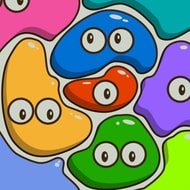








You drop a small blob into the cup, watch it bounce once against the glass, and settle next to an identical one — and the second they touch, both vanish into a single larger blob with a satisfying pop. That’s the entire loop of Blob Drop, and it’s deceptively hard to stop playing once it starts.
| Genre | Merge puzzle |
| Controls | Drop blobs into a cup |
| Win Condition | None — score run until overflow |
| Fail Condition | A blob crosses the danger line |
The Merge Rule at the Center of Blob Drop
Only two blobs of the exact same tier merge into the next size up — a mismatched pair just sits there taking up space. Beginners often assume any collision helps, but stacking two different tiers side by side is actually one of the fastest ways to fill the cup without making real progress.
The tier ladder runs from small starter blobs up through several size jumps, and each merge produces a blob two steps more valuable than either of the ones that combined, which is what makes chain merges so much more efficient than one-off pairings. A single merge near the bottom of the ladder barely dents the available space in the cup; a merge near the top can clear out a stack that took a dozen drops to build.
Watching where a dropped blob will actually land, rather than just where you release it from, becomes second nature after a few runs — the physics carry it slightly past your drop point almost every time, and blobs that look like they’re heading for open space often roll just far enough to touch a neighbor.
Reading the Danger Line Before You Panic
The dashed line near the top of the cup is the real end condition in Blob Drop — cross it with a settled blob and the run ends immediately, regardless of how much open space remains lower down. New players often panic-drop small blobs into open gaps near the top just to clear queue space, which is usually the exact mistake that pushes a stack over the line a few drops later.
A calmer approach treats the danger line as a budget: every drop into the upper third of the cup should be justified by an immediate merge, not just a need to get rid of the next blob in queue. Drops that don’t merge should go low and to the side, where there’s room to work with them later, rather than adding height right under the line.
Corners of the cup fill up faster than most players expect, since blobs settle against the glass walls and stay put instead of rolling toward the center. Keeping an eye on both corners, not just the middle column, is often the difference between a run that ends abruptly and one that keeps finding room.
Planning Two Drops Ahead
The game always shows the next blob waiting to drop, and players who only look at the current one tend to make short-sighted placements. Planning around both the current and next blob is what lets a chain reaction happen instead of a lucky single merge — dropping the current blob next to a matching pair specifically because you know the next one completes a different merge is a habit that separates consistent scorers from players relying on luck.
One of the more debated points among regular players is whether stacking tall in a single column is a stronger strategy than spreading merges wide across the cup — tall stacks make bigger blobs faster but leave almost no room for error near the danger line. Spreading wide is safer but slower, and it tends to leave more small, unmerged blobs cluttering the base of the cup by the time a run gets long.
Most experienced players settle on a hybrid: build width across the bottom two-thirds of the cup early, then commit to a single tall column only once the board is otherwise under control and the danger line still has real breathing room above it.
Chain Reactions and the Biggest Blobs
The most satisfying moments in Blob Drop come from a single drop triggering three or four merges in sequence, each new blob immediately touching another matching one from a previous setup. Getting a chain like that to happen on purpose, rather than by accident, takes a genuine sense for how far a falling blob will roll after it lands, and for which tiers are already sitting close enough together to cascade.
Reaching one of the largest tiers on the ladder is the community’s informal benchmark for a good run, and it’s rare enough that most players remember the specific drop that finally got them there. Getting close to that tier usually means the cup is already dangerously full, which is part of why the biggest merges tend to happen right before a run ends rather than in the middle of a comfortable stretch.
What Beginners Get Wrong in Blob Drop
The single biggest beginner mistake is treating every drop as urgent. Because the next blob queues up immediately, new players feel pressure to place it right away, when the game rarely punishes taking an extra second to line up a better spot. There’s no timer working against you — only the height of the stack.
The second common mistake is ignoring the sides of the cup in favor of the center. Center drops feel intuitive because that’s where most blobs visually seem to land, but the edges of the cup often hold the safest long-term storage for blobs that don’t have an immediate match.
Do different-sized blobs ever merge with each other?
No, only two blobs of the identical current tier merge — combining a small blob with a larger one just leaves both sitting in the cup taking up space.
What actually ends a run in Blob Drop?
The run ends the moment a settled blob crosses the dashed danger line near the top of the cup, even if there’s still open space lower down.
Is it better to stack tall or spread out?
Spreading wide gives more room for error near the danger line, while stacking tall reaches big merges faster but leaves very little margin if a drop goes wrong.
Blob Drop’s whole appeal sits in that tension between wanting one more drop and knowing the danger line is closer than it looks — every merge buys a little more room in the cup, and every mismatched pair quietly eats into it, which is exactly why one more round always feels worth trying even after the last one ended in an overflow right at the edge.