







What actually happens when you stop trying to move the bear and start trying to move everything else instead? That’s the question La Madriguera puts in front of you the moment you realize the armchair isn’t going anywhere, and it’s the question that ends up defining every single attempt you make at the den’s one puzzle.
| Genre | Physics-based puzzle |
| Setting | A cozy, cluttered burrow built around one armchair |
| Main Goal | Deliver a slice of cake to the seated bear |
| Controls | Mouse drag for interaction, R key to reset the room |
A Bear Who Refuses to Leave the Armchair
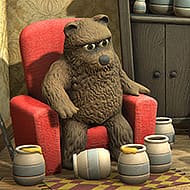
The setup for La Madriguera is deliberately narrow: a large, sleepy bear sits deep in his armchair at the back of a burrow, and a slice of chocolate cake waits on a nearby table just far enough away to be a problem. Standing up is presented as a non-option from the first few seconds, and that single restriction shapes the entire design. Instead of controlling the bear’s legs or body, you take charge of one long paw that can stretch toward nearby objects and drag, tip, or fling them.
This isn’t a small stylistic choice. Because the bear physically cannot relocate, every obstacle in the room has to be solved through indirect manipulation, which is a much harder design problem for the developers than a normal walk-and-grab puzzle, and it shows in how carefully the den’s objects are weighted against each other.
Once you internalize that limitation, the burrow stops feeling like a static backdrop and starts feeling like the actual game board.
How Grabbing and Dragging Actually Works
- Move the mouse to slide the bear’s paw across the reachable radius of the armchair
- Click and hold on an object to grip it, then drag to reposition, tip, or swing it
- Release at the right moment to let physics carry the motion forward
- Press R at any point to reset the entire den if a setup collapses badly
The four steps above cover the entire control scheme, and that’s intentional — the puzzle’s depth is supposed to come from the arrangement of objects, not from a complicated input system. Because everything runs on live physics rather than pre-set outcomes, the exact same drag can produce a slightly different result twice in a row if the angle changes even a little.
Reading the Room: Furniture as Function
Beginners tend to look at the table, the lamp, the rug, and the stack of books as decoration, and that assumption is the single biggest reason first attempts fail. Every prop in La Madriguera is load-bearing in some way. The table can be angled to become a ramp. The lamp’s cord doubles as an improvised pulley if you catch it at the right point. The rug slides objects sitting on top of it whenever you tug one corner.
By the time most players reach their third or fourth reset, they’ve usually stopped asking “what do I move” and started asking “what does this object actually do,” which is a much better question for this specific game.
The Fork Problem Everyone Talks About
No single object generates more discussion than the fork resting near the bear’s chair. Stretched out, it becomes a hook capable of reaching across gaps that look completely impassable from the paw’s normal range. Early in the game, before this trick is discovered, players routinely try to solve everything by manhandling the table directly, which almost always ends with the cake catapulted somewhere unreachable instead of somewhere useful.
Forums built around the game treat the fork moment as a kind of unofficial checkpoint — the point where a player has genuinely understood the mechanics rather than just fumbled into a lucky outcome.
What Beginners Consistently Get Wrong
The most common mistake is force. New players tend to yank objects hard and fast, which in a physics-driven room usually causes a chain reaction that buries the cake under a fallen lamp or a toppled stack of books. A slower, more deliberate drag almost always produces a more predictable result, since the underlying physics rewards control over speed.
A second common error is ignoring the rug entirely, since it looks purely cosmetic until a player accidentally discovers it can carry weight across the floor.
Where the Design Gets Divisive
Not everything about the experience lands cleanly. Because La Madriguera ships with only one burrow and one puzzle to solve, some players finish it in under ten minutes and feel like the concept deserved more rooms to explore. There’s also a recurring complaint in reviews about subtitle text occasionally displaying in the wrong language depending on which version is running, which is a small but noticeable rough edge for a game this compact. Both criticisms come up often enough in player discussion that they’re worth mentioning honestly rather than glossing over.
What Players Ask Most Often
- How long does it take to finish the puzzle? Most first attempts land somewhere between five and twenty minutes depending on how quickly a player finds the fork trick, since the single burrow doesn’t require exploring beyond the armchair’s immediate surroundings.
- Do you ever control the bear directly? No — every solution routes through the paw and the surrounding objects like the fork, the table, and the rug, since the bear himself never leaves the armchair.
- What’s the fastest way to get unstuck? Reset with the R key and try stretching the fork toward the table’s edge first, since most stuck states come from having already knocked over an object needed for the intended path.
Strip away the humor and La Madriguera is really a study in restriction: one paw, one fork, one armchair, and a bear who isn’t moving no matter how badly that cake gets knocked around.