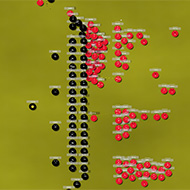








You watch a neutral cell sit undefended a few seconds too long, send half your dot army to grab it, and immediately regret it when a rival column swings in and claims your weakened home base instead. That is a normal five minutes in Battle Of Dots : The Last Stand, a fast real-time strategy game that strips everything down to cells, dots, and timing, where every choice about where to send your army gets punished or rewarded almost instantly.
| Genre | Real-Time Strategy |
| Perspective | Top-Down |
| Core Focus | Cell Capture and Army Management |
| Best For | Fans of Fast Minimalist RTS Rounds |
Capturing Cells and Managing Your Dot Army in Battle Of Dots : The Last Stand
Every match starts the same way: a handful of cells belong to you, a handful belong to a rival, and the rest sit neutral. Sending your dot army against a neutral cell is cheap and low risk, but committing too many dots to one push leaves your own cells thin, exactly when an opposing column tends to arrive. Beginners consistently overcommit early, chasing every neutral cell instead of holding a defensive reserve.
Upgrading buildings changes the pace of a round more than new players expect. A cell with an upgraded production building churns out dots faster than a bare one, so defending two or three central cells often beats spreading thin across six weak ones.
The moment that trips up most first-time players is realizing a cell can be recaptured the instant it runs low on defenders, even seconds after taking it. That single detail turns the game from a simple land grab into a constant balancing act between offense and holding the line.
Attack Timing and Defense Choices in Battle Of Dots : The Last Stand
Once a match settles into its middle stretch, the difference between an aggressive rush and a patient buildup becomes obvious. Rushing early can catch an unprepared rival off guard, but it leaves your own cells exhausted if the attack stalls out. Defense-minded players who reinforce their strongest cells before pushing outward tend to win longer matches.
Coins earned during play buy skins for defense buildings, towers, and individual fighters, which changes nothing about the actual battle but lets regulars recognize each other’s builds at a glance.
Things worth watching for in a round:
- Neutral cells near the map edge are left undefended longer than central ones
- Weakened cells recover defenders slowly, making them easy recapture targets
- Splitting your dot army across two fronts usually costs more than it earns
Whether a rush strategy or a slow buildup wins more often is debated among regulars, and the honest answer depends on how quickly the rival responds to early pressure. Both approaches fall apart against a defender who reinforces at the right moment instead of the obvious one.
Battle Of Dots : The Last Stand keeps rounds short enough to replay right after a loss, and once you start reading which cells are actually undefended instead of just counting dots, holding your own line stops feeling like guesswork.