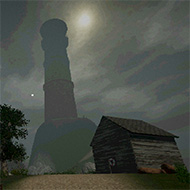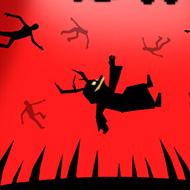








In Out Here you start alone in a lighthouse during a storm, with nothing but an emergency radio, a map of the surrounding waters, and the tower’s height as your only real advantage. A stranger’s voice cuts through the static almost immediately, panicked, saying something surfaced out on the water and that he needs your help getting his boat to shore. That is the entire setup, and it never really explains more than that before putting the radio in your hand.
| Genre | Narrative survival horror |
| Play Mode | Single session, choice-driven |
| Setting | An isolated coastal lighthouse at night |
| Core Challenge | Guiding a stranger through darkness with limited information |
The Radio Call That Starts Out Here
The fisherman’s voice is the first thing you actually get to know in Out Here, and it stays the emotional center of the entire run. He never identifies what came up out of the water, only that it is enough to make an experienced fisherman sound genuinely afraid over a crackling radio line. This leans on that voice acting, rain, and static far more than on anything visual for its first unsettling minutes, and that choice is deliberate.
Early on, you have almost no context for why the other lighthouses along the coast have gone dark, and Out Here does not rush to explain it. That silence is part of what players bring up most when they talk about the game afterward, since the mystery is never fully resolved by the time the credits roll.
Players who go in expecting a jump-scare heavy horror game are usually surprised by how quiet Out Here actually is for most of its runtime, relying on dread built through the radio conversation rather than sudden shocks. The scares that do land tend to work because the quiet made you lower your guard first.
Reading the Map From the Lighthouse Tower
Once the fisherman is on the water, guiding him becomes a matter of reading your map against what little you can see from the tower and relaying directions back over the radio. The lighthouse’s elevated position is your only real tool here, since the water itself is close to unreadable in the dark without it.
Beginners tend to give directions too quickly, reacting to the fisherman’s panic instead of actually confirming his position on the map first. Out Here does not punish hesitation the way a typical horror game might, but a rushed or wrong call here changes how the rest of the run plays out, sometimes in ways you will not notice until much later.
By the time you have guided him past the first hazard, the rhythm becomes clear: listen, check the map, then speak. Players who skip straight to speaking tend to be the ones who end up backtracking their own instructions moments later.
What the Water Hides From You in Out Here
Out Here never fully shows you whatever emerged from the water, which is exactly why the moments where you can almost make something out linger with players long after a run ends. The game trusts implication over a clear reveal, and that restraint is one of the most discussed choices in the entire experience.
This is where the Lovecraftian influence in Out Here is most obvious, favoring dread about scale and the unknown over a monster you could describe afterward. Some players find that satisfying, while others wanted a clearer answer by the end, and that disagreement shows up constantly whenever the game comes up in conversation.
What almost everyone agrees on, regardless of which side of that debate they land on, is that the sound design carries more of the horror than anything you actually see on screen.
Minimal Combat and Where the Tension Actually Comes From
Out Here gets filed under survival horror, and yet there is barely any combat to speak of; the closest thing to a weapon is your own voice on the radio. That absence surprises players expecting to eventually fight back against whatever surfaced out of the water, and it never really arrives.
Instead, the tension comes entirely from information you do not have: how far away the boat actually is, whether your last direction was understood correctly, and what the silence on the other end of the radio means each time it stretches a little too long. Players who go in expecting a weapon or a chase sequence tend to describe the pacing as slow at first, before the radio silence starts doing the work a jump scare normally would.
That design choice is one of the more debated aspects of the entire experience, since some players wanted a more active threat to respond to rather than passive dread. Others argue the restraint is exactly the point, and that a visible monster would have undercut everything the radio conversation built.
Multiple Endings and Whether You Can Actually Save Him
Out Here branches based on the directions you give and how quickly you give them, leading to several distinct endings by the time the fisherman either reaches shore or does not. Community discussion around the endings tends to agree on one uncomfortable point: full success feels less guaranteed than a typical rescue scenario, and more than one outcome reads as a tragedy in a different shape rather than a clean victory.
That structure answers a question a lot of players search before starting, whether there is a true good ending. There is a best outcome relative to the others, but Out Here is built so that even careful, correct play does not erase the sense that something was lost along the way.
A second common question is how long a single run actually takes. Out Here is built to be finished in one sitting, short enough that replaying it to see a different ending is a realistic thing to do the same evening rather than a separate commitment.
Sound and the Details Only Players Notice
The specific crackle pattern of the radio going quiet right before the fisherman speaks again is the kind of detail that only registers once you have played through Out Here more than once. Players frequently mention it as the moment that gets them every time, regardless of how many runs they have done.
None of the audio cues are labeled or explained, so noticing them is entirely a matter of paying attention during a run rather than being told what to listen for. That is part of why replays feel different from a first attempt even when the choices made are identical.
- Rain intensity shifting subtly during tense moments, easy to miss on a first run.
- Radio static that briefly distorts the fisherman’s voice right before key decision points.
- The visible horizon narrowing the longer the boat stays out on the water.
None of these details are explained directly, which is consistent with how the game handles almost everything else about its mystery. Noticing them on your own is part of what makes a second run feel worthwhile.
A Typical Run, Start to Finish
Laid out plainly, the shape of a run is simple enough to describe in a few steps. Living through it rarely feels that orderly once the radio starts crackling and the fisherman’s voice rises in panic.
- The radio crackles to life and the fisherman explains something surfaced out on the water.
- You orient yourself using the map and the view from the lighthouse tower.
- You relay directions back over the radio as the fisherman’s boat moves through the dark.
- Tension builds as the horizon narrows and the radio contact becomes less steady.
- The run resolves into one of several possible endings based on your earlier calls.
Knowing the shape in advance does not make the middle of a run feel less tense, since the actual pressure comes from not knowing which of your calls will matter until it is too late to take one back.
That structure is short enough to replay immediately, and most players do exactly that the first time they see an ending they did not expect from Out Here. A second run rarely plays out the same way twice.
Out Here earns its reputation on restraint rather than spectacle, trusting a panicked voice on a radio and a map you can barely read in the dark to do more than any visible threat could. What stays with you afterward is not the fisherman being saved or lost, it is the radio static settling back into silence once the water goes quiet again.