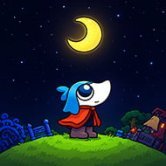








MONOMOON looks like a small pixel platformer starring a cute feathered creature, but it plays like a notebook mystery where nobody explains the rules. There is no combat and no dialogue, and nothing tells you what to do. Everything you learn comes from watching, testing and reading a strange book.
| Genre | Puzzle platformer, often called a Metroidbrainia |
| Platform | PC (Steam) |
| Players | Single-player |
| Combat | None |
| Main quests | Around 10 hours |
Reading the Book and Collecting Feathers in MONOMOON
Early in your journey you pick up a book from a desk, and it is completely empty. The pages fill in as you collect feathers scattered around the world. Some pages give direct hints about how a creature behaves, while others are cryptic diagrams that make no sense until the right moment. A few show the inhabitants of the world and a symbol-based numerical language, so the book works as both manual and lore.
Pages come in no fixed order, and that shapes how the game feels. You might find a diagram long before you have seen anything it applies to. Players who keep notes or screenshots tend to do better here, because a page that looked like decoration at hour two can be the answer to a problem at hour six.
Feathers are worth chasing even when they look like detours. Every one is a piece of the manual you are building yourself.
One Hand on the Creature, One on the Moon
You control two things at once: the creature that runs and jumps, and the moon that guides it. That is why a keyboard and mouse are the recommended setup. The keyboard handles movement while the mouse moves the moon, and the moon is a real tool rather than decoration. Its blue glow reveals secrets that are invisible on certain book pages, and it also acts on the world itself.
Anything marked with a moon-shaped insignia can be activated. That covers platforms, certain objects and parts of your inventory, and creatures can be interacted with as well. Players who come from Metroidvania games often try to solve everything with jumping first. The better habit is to point the moon at anything suspicious before deciding a gap is impossible.
- Shine the moon over every book page, since some pages hide extra content until the glow touches them.
- Hover the moon over unfamiliar objects and see what reacts.
- Watch how each creature behaves before trying to move past it.
The moon steals attention from the platforming in a good way. It makes the whole game feel like a conversation between you and the world.
What Beginners Get Wrong in MONOMOON
The most common mistake is expecting a goal to appear. The game never states one, so new players wander and get frustrated within the first hour. The fix is a change of mindset. Treat every screen as a question, and when something looks odd, assume it is a clue until proven otherwise.
The second mistake is rushing through the main quests. They take around 10 hours, but the game is built so that finishing is only part of the picture. Players who sprint to the credits miss layers of secrets, and many say the post-credits stretch is where the best discoveries are.
Puzzle fans who enjoy cracking systems alone will feel at home, since all the clues live inside the game itself and no outside help is required. Players who like talking through theories can also enjoy it, because comparing notes with friends is encouraged even though the game is strictly single-player.
Cipher Pages and the Numerical Symbol Language
The symbols in the book are the layer that gets the community talking. Players describe the writing as a made-up language, with numerals and glyphs that slowly start to mean something. Because the game has no spoken words, decoding that text becomes the closest thing to a story you can read. Treat it as a puzzle in itself, not as background art.
You will notice small things that only come from playing. The game opens on a soft piano melody that stays dreamy throughout, and stars twinkle in the background of nearly every screen. The feathers on your creature’s head bob as you hop around, and these details make a tiny open world feel alive even when you are stuck.
Puzzle solvers who enjoy ciphers will probably end up with a notebook beside the keyboard. Anyone who prefers instant feedback may find this style demanding, because a code can sit unsolved for hours before a page appears that unlocks it.
Why the Credits Are Not the End
Many puzzle games treat the final screen as a finish line, but MONOMOON is designed around coming back. The store page itself says the game does not end when the credits roll. Players talk about a first run to learn the world, followed by a second look with everything the book taught them. Secrets hiding in plain sight start to make sense once you know what the pages were hinting at.
That structure is why people compare the game with other hidden-depth puzzle adventures such as Animal Well. The comparison is about the feeling of layered mysteries and rules you have to discover yourself. In MONOMOON the world is small, so every screen carries weight, and revisiting areas feels productive rather than repetitive.
Early praise from players focuses on exactly this. They enjoy the sense that a tiny map can still hold a lot of secrets, as long as you look closely enough.
Late Pages and an Unclear Map: Honest Complaints
Not everything works perfectly. Because the world is non-linear, some players find a book page after they have already struggled through the problem it explains. Several creatures can be worked out alone, but others are hard to read without a proper hint, and that is where patience runs out. If you dislike vague guidance, expect some frustration.
The map is another point that comes up often. Some reviewers say it could be clearer, and in a game built on backtracking, a confusing map makes returning to old spots harder than it needs to be. Taking your own notes about where unsolved things sit is a sensible workaround.
Whether the lack of instructions counts as a strength or a flaw depends on the player. Most players call it the whole point, while a smaller group would like a gentler nudge now and then.
Questions Players Ask Before Starting MONOMOON
Is there any combat in MONOMOON?
No. The game removes fighting entirely, so your tools are the moon, your creature’s movement and the knowledge stored in the book. Danger comes from misreading how a creature behaves, not from losing a duel, which keeps the focus on puzzles.
How do I get more pages for the book?
Pages appear when you collect feathers around the world. Some pages stay hidden until you shine the moon over them, so check each new page with its blue glow. If a page looks blank or confusing, come back to it after finding more feathers.
How long does MONOMOON take to finish?
The main quests take around 10 hours, but that figure only covers the first pass. Secrets continue after the credits, including hidden mechanics and the symbol language in the book, so thorough players can spend noticeably longer exploring everything.
MONOMOON asks you to trust your curiosity, an empty book and a moon that reveals more than it first appears to. If you enjoy filling in the book page by page, shining the moon over every strange corner and decoding the symbol language, this is the kind of world you will want to keep returning to.