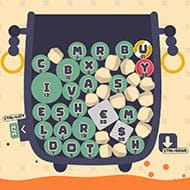








You drop three letters into a bubbling cauldron and watch two of them slide together, doubling in size right before the bubble pops into your hand as a bonus. That merge is the first thing Lexispell teaches you, and it never really stops teaching you new tricks after that. Underneath the potion-cluttered art style sits a roguelike spelling game where the letters themselves behave like physics objects, rolling and colliding inside a cauldron instead of sitting quietly in a rack. Every run asks you to clear a set number of rounds by hitting a score threshold, and the letters you have on hand determine whether that threshold feels comfortable or brutal.
| Genre | Roguelike word game |
| Platform | PC, Steam Deck |
| Stages per Classic Craft run | 12 |
| Boss encounters | 20+ |
Merging Letters Inside the Cauldron
The core loop starts with a cauldron full of letter bubbles. You drag matching letters toward each other, and when two touch they merge into a single bigger bubble worth more points, the same growth pattern players recognize from Suika-style stacking games. Once you have letters you like, you spell the highest-scoring word you can manage and send it off, clearing space for whatever drops in next. Ring the bell above the cauldron and fresh letters tumble in, but overfill the pot and you lose room to maneuver, which is the first thing new players get wrong.
Beginners tend to chase the longest word available the moment it appears, without checking whether a shorter word using a merged, high-value bubble would score more. Letter score plus a multiplier decides your total, so a five-letter word built from small bubbles can lose to a three-letter word anchored by one letter you merged three times over. Get comfortable reading bubble size before committing to a spelling.
Between rounds, a shop offers scrolls, runes, and items bought with currency you earn by hitting your target score quickly rather than just eventually. Spend early on anything that widens your letter pool; spend later on multiplier scrolls once your vocabulary under pressure improves. That shift in shopping priority is something most Lexispell runs teach you by round four or five, usually the hard way.
Boss Fights That Rewrite the Rules
Every third round in Classic Craft is a boss fight, and this is where the game earns its reputation. Instead of simply raising the score you need, each boss changes a rule you assumed was fixed. One boss strips all points from vowels, forcing you to lean on consonant clusters you would normally ignore. Another shrinks the letter pool itself, or exaggerates the Suika-style growth so bubbles get physically bigger and harder to arrange in the limited space of the cauldron. With more than twenty bosses assigned at random each run, no two boss stretches play identically, and that randomness is a big reason players keep starting new runs instead of grinding one seed.
One particular boss removes standard word rules entirely and demands every valid word repeat a single letter for the fight’s duration, a twist that catches most first-timers completely off guard mid-run. It is the kind of moment players bring up in Discord screenshots because it breaks an assumption you did not even know you were relying on.
By the time you reach the later boss rounds, difficulty stops being about vocabulary size and turns into resource management: when to burn a wand, when to save a rune for a worse fight two rounds later. Three difficulty levels exist for the base score thresholds, and even on the easiest of them a badly timed boss can end a run that felt safe a minute earlier.
Classic Craft, Letter Rush, and the Jar Mode
Classic Craft structures the twelve stages around a score threshold rather than a clock, which gives newer players room to actually think through a bubble arrangement. Letter Rush removes that patience entirely, dropping letters continuously so spelling quickly becomes the only thing keeping the cauldron from overflowing. Jar mode strips out the constant drops altogether, handing you a fixed pool of letters to squeeze as many words from as possible, closer in feel to a locked crossword than a falling-tile game.
- Classic Craft favors players who like planning around merges and saving items for boss rounds
- Letter Rush suits players chasing reflex-driven word recognition under pressure
- Jar mode rewards players who enjoy squeezing every possible word from a closed set before it dries up
Daily Challenge sits alongside these modes with a fixed seed shared by everyone that day, and it is where the leaderboard-focused crowd spends most of their time, comparing scores from an identical starting cauldron rather than a random one.
Scrolls, Runes, and Backpack Choices in Lexispell
Your backpack holds the special tiles that separate an average Lexispell run from a strong one: gem letters that carry extra value, hashtag wildcards that fill any gap in a word, and asterisks or exclamation marks that stretch your effective letter count when the cauldron runs thin. Hoarding these for a boss round is usually smarter than spending them the moment they appear, since an early word rarely needs the rescue as badly as a late one does.
Alphabet-based scrolls add a small multiplier for every distinct letter of the alphabet you have used across a run, with a large bonus once you have touched all twenty-six. Chasing that bonus changes how you build words in Lexispell, nudging you toward rarer letters you would otherwise avoid, and it is a strategy players openly argue about on the game’s Steam forums since it can slow down your early score pace for a payoff that only lands late.
Where Lexispell’s Difficulty Really Comes From
The base game, on its lowest of three difficulty settings, is not especially hard to clear. What makes Lexispell demanding is the intersection of random boss assignment and a shrinking margin for error as merged bubbles grow larger and harder to fit inside the cauldron without accidentally triggering an unwanted merge. Space management becomes a real constraint by the later stages, not just a flavor mechanic from round one.
Word game veterans sometimes underestimate this because they assume vocabulary alone will carry them.
It does not, not once bosses start removing categories of letters or shrinking the pool you can draw from.
Community Habits Around Daily Challenges
Some players treat Lexispell as a relaxing wind-down session with chill music playing in the background, clearing a Jar mode board slowly with no pressure to optimize. Others check the Daily Challenge leaderboard every morning and treat that identical shared seed as the real competitive format, comparing merge choices with people who started from the exact same cauldron. A third group is mostly there for the boss variety, running Classic Craft repeatedly just to see which of the twenty-plus encounters shows up next.
It is worth being honest that the web build can lag during longer sessions, and several players have asked for higher contrast between letter bubble colors since some tiles blend together in Letter Rush rounds. Neither issue breaks the game, but both come up often enough that new players should expect them.
How does merging work in Lexispell?
Matching letter bubbles that touch inside the cauldron combine into one larger bubble, similar to Suika-style stacking, and that merged bubble is worth more points than its two smaller versions combined. Bigger bubbles take up more room, though, so unchecked merging can crowd the cauldron and limit your next spelling options.
What happens when a boss removes vowel points?
Vowel-stripping bosses zero out any scoring bonus your vowels would normally provide, which pushes you toward consonant-heavy words and any gem letters or wildcards sitting in your backpack. Runs that stockpiled hashtag tiles beforehand tend to survive this boss far more comfortably than runs that spent them early.
Which Lexispell game mode is best for beginners?
Classic Craft is the friendliest entry point because its twelve stages are cleared by score threshold rather than a timer, letting you study bubble placement before committing to a word. Letter Rush and its constant letter drops are better saved for once you are comfortable reading merges quickly.
Lexispell keeps its cozy, potion-lined surface while quietly testing whether you can adapt when a boss yanks the alphabet’s usual rules out from under you, and that tension between comfort and demand is exactly what keeps players returning to the cauldron for another run.