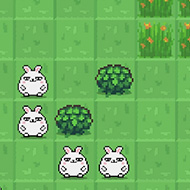








In Hoply you start each level with a fixed number of moves and a board full of bunnies that all need to reach a safe tile before that count runs out, and nothing about the rules gets any easier once the first jump is spent. It looks like a gentle grid puzzle at first glance, but the wolves waiting just off-screen make it clear early that this game does not forgive wasted moves.
| Genre | Grid-based hopping puzzle |
| Levels | 25 plus a tutorial |
| Controls | Mouse or touchscreen |
| Objective | Guide every bunny to a safe tile within the move limit |
How a Single Move Chains Into a Long Jump in Hoply
The core rule sounds simple: a bunny can step to a neighboring cell, or jump over a bush or another bunny sitting next to it. What makes Hoply click is what happens after that jump lands, because a bunny that clears one obstacle can immediately jump again if another bush or bunny sits in its new path. A single move can chain across most of the board this way, which turns what looks like a short hop puzzle into something closer to a chain-reaction planning problem.
New players tend to move one bunny at a time without checking whether that move blocks a second bunny’s only path to safety. Since bunnies themselves count as jumpable obstacles, repositioning one can open or close a chain for another, and missing that interaction is the single most common reason a level suddenly looks unsolvable with moves still left on the counter.
Once the chaining mechanic clicks, planning shifts from moving bunnies individually to thinking about the order moves happen in, since the same board can be solvable or unsolvable depending purely on sequence.
Reading the Grid Before the First Bunny Moves in Hoply
Bushes on the board never move, but they define almost every viable path a bunny can take, since they are what makes chained jumps possible in the first place. Scanning the full grid before committing to a first move is worth the pause, because an early move made out of habit can strand a bunny in a corner with no bush or neighbor left to jump.
Players who enjoy Hoply’s harder levels tend to work backward from the safe tiles, figuring out which bunny needs to land there last and building the rest of the sequence around that constraint. Others prefer working forward from the most boxed-in bunny on the board, clearing the tightest spot first before it gets any tighter.
- Step to an open neighboring cell
- Jump over a bush directly in the bunny’s path
- Jump over another bunny occupying the next cell
- Chain an additional jump immediately after landing, if another obstacle lines up
What Happens When Hoply’s Move Counter Hits Zero
Running out of moves before every bunny reaches safety ends the level immediately, and the wolves that appear at that point are less a mechanic to dodge than a visual signal that the attempt is over. There is no partial credit for getting most of the bunnies to safety, which makes the counter feel tighter than it looks once a level is halfway solved.
This is where the level constructor becomes relevant for players who finish the main 25 levels and want more. Building a custom board makes the chaining rule easier to internalize, since designing a solvable puzzle forces a player to think through the same bush and bunny interactions from the opposite direction.
Completionist players tend to replay finished levels looking for a shorter move sequence, while players just working through the campaign are usually satisfied clearing a level in any number of moves the counter allows.
How many levels does Hoply have?
The main campaign includes 25 handcrafted levels on top of an introductory tutorial that walks through the step, jump, and chain rules individually before combining them.
What happens if a bunny gets boxed in with no bush or neighbor nearby?
That bunny is stuck until another bunny moves close enough to become a jumpable obstacle itself, which is why move order matters as much as move choice in tighter layouts.
Is there a way to plan a full solution before making the first move in Hoply?
Experienced players generally trace the chain visually before touching the board, since the mouse-only controls make it easy to test a path with the eyes first and commit only once the full sequence looks sound.
Hoply turns a simple hopping rule into a genuinely tricky planning puzzle once bushes, bunnies, and chained jumps start interacting on the same board, and reaching that final safe tile with a bunny to spare feels earned rather than accidental.