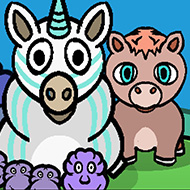








You click the horse and a small pile of droppings hits the pasture floor, and somewhere off-screen a counter ticks upward. That single, ridiculous interaction is the whole engine behind Giant Horse Feeding, a colony sim that turns feeding time into the seed of an alien civilization. Within a couple of minutes the pile becomes a stockpile, the stockpile becomes fuel for a factory, and the factory becomes the reason you keep clicking long after the joke of the premise wears off.
| Genre | Simulation, incremental colony builder |
| Core resource | Horse droppings |
| Skill tree | Three upgrade camps |
| Achievements | 23 unlockable achievements |
| Art style | Hand-drawn, colorful |
How Giant Horse Feeding Turns Droppings Into a Colony
The premise sounds like a throwaway joke and plays like a real production chain. You feed the horse, the horse produces droppings, and those droppings become the base currency for everything else you build. What starts as a single pile you tap by hand quickly turns into a pipeline: droppings get hauled off, processed, and converted into the “valuable materials” that fund your alien colony’s expansion. The game never explains why aliens settled on manure as a foundation for civilization, and it doesn’t need to; the joke carries the mechanics instead of getting in their way.
Early sessions are almost entirely about rhythm. You feed, you collect, you spend. There’s no penalty for clicking too fast, and the game rewards attention more than precision, which matters for a genre where a lot of games punish you for looking away.
Players who gravitate toward incremental games will recognize the shape immediately, even with the horse-and-manure skin layered on top. The word “game” gets used loosely by fans here, since a lot of the appeal is closer to a fidget toy with a scoreboard attached, but that’s part of why it holds attention during short sessions.
The Feeding Loop in Giant Horse Feeding’s Opening Minutes
The first real decision point comes once your dropping stockpile is big enough to fund the first piece of alien machinery. That’s the moment Giant Horse Feeding stops being a single-button toy and starts asking you to think about allocation: do you sink your stockpile into faster feeding, or into machinery that processes what you already have more efficiently. Most new players spend everything on feeding speed first, because watching the number go up faster feels good, and only later realize that processing capacity is the actual bottleneck.
That early misstep is one of the more common things beginners get wrong. Feeding fast without anywhere for the droppings to go just creates a backlog, and backlogged resources sit there doing nothing.
Alien Machinery and the Processing Chain
Once the first factory building is up and running in your colony, droppings stop being an end product and become raw input. Alien machinery takes over the conversion work, turning a resource nobody would want in real life into the “valuable materials” that unlock everything downstream, from colony expansion to new production lines. Each additional structure you place adds another link to that chain, and the game leans hard into the absurdity of an entire alien economy running on horse waste.
By the time you’ve placed a handful of these buildings, the loop mostly runs itself, and your attention shifts from individual clicks to managing throughput. This is where the “incremental” half of the genre label takes over from the “clicker” half, and it’s also where the pacing starts to matter more than reflexes. Players who enjoy pure automation games tend to linger here the longest, since watching a self-sustaining chain hum along is the actual reward, not the initial clicking.
Working Through the Skill Tree’s Three Camps
Progress beyond the early factories runs through a skill tree split into three camps of upgrades, each one nudging a different part of the loop: feeding output, processing efficiency, and colony expansion. Unlocking a new tier in any camp usually unlocks a slightly more ridiculous version of the technology before it, which keeps the alien-civilization joke going even as the systems underneath get more serious.
This is also where community opinion gets more mixed. Some players enjoy chasing every branch across all three camps for completion’s sake, while others feel the tree runs out of meaningfully different choices well before the achievements do.
- The feeding camp raises how much a single tap or automated cycle produces.
- The processing camp improves how efficiently alien machinery converts droppings into materials.
- The expansion camp unlocks new colony structures and territory for the alien settlement.
Where Giant Horse Feeding’s Pacing Gets Skewed
Here’s the honest part players bring up most: the skill tree’s cost curve is uneven. Several early upgrades in each camp are cheap and satisfying to grab in quick succession, and then a single node demands a disproportionate stockpile before the next batch of cheap ones opens back up. It’s a legitimate criticism, and one that shows up repeatedly in player discussion around the game rather than being a one-off complaint.
The upgrade variety itself is on the smaller side too, with a handful of repeatable improvements spread across the three camps rather than a long list of unique ones. For players who want an idle game to run in the background while they do something else, that’s not necessarily a problem. For players chasing constant novelty, it can make the middle stretch feel repetitive before the alien colony reaches its later, more elaborate stages.
Achievements and the Long Recycling Grind
Giant Horse Feeding ships with 23 achievements, and they’re spaced out in a way that pulls you well past the point where the core loop stops feeling new. Some track simple milestones, like your first fully automated production line, while others reward sticking with a single camp of the skill tree until it’s exhausted.
Completionist-minded players are the ones most likely to see all 23, since casual sessions tend to stop once the colony is self-sufficient and the novelty of feeding a horse for a living has worn off. The droppings-to-materials cycle keeps going regardless of whether you’re chasing achievements, which is part of what people mean when they call it a “recycling loop” in reviews: the horse never stops producing, and the colony never stops needing more.
What Players Ask About Giant Horse Feeding
Why does the skill tree in Giant Horse Feeding feel so uneven?
Because the cost scaling inside each of the three camps isn’t smooth. A run of cheap, quick upgrades is regularly followed by one expensive node that forces you to stockpile droppings for a while before you can keep progressing, which is the pacing complaint players raise most often.
How many achievements does Giant Horse Feeding have?
There are 23 achievements total, covering everything from early automation milestones to fully investing in a single upgrade camp, giving completionists a reason to keep the colony running well past the opening hour.
Is there real variety in Giant Horse Feeding’s upgrades?
Not a huge amount. The three camps cover feeding output, processing efficiency, and expansion, but each camp leans on a handful of repeatable upgrades rather than dozens of unique ones, which is the most common criticism among players who stick around for the long haul.
What makes Giant Horse Feeding memorable isn’t the horse itself so much as watching a joke about droppings turn into an actual functioning alien economy, complete with a skill tree, three distinct upgrade camps, and a factory chain that keeps humming long after you’ve stopped clicking by hand. It’s a small, silly loop, but it’s a complete one, and that combination is exactly why it holds attention past the first punchline.