







You watch the platform tilt under your feet a half-second before it gives way completely, and there’s no time to think, only to jump. That’s the rhythm Fall Red Stickman runs on from the first stage: quick reads, quicker reactions, and a character built out of loose limbs and worse instincts than you’d like.
| Genre | Physics-based obstacle platformer |
| Platform | Browser |
| Core mechanic | Guide a red stickman across collapsing and moving terrain to reach the finish line |
| Controls | Directional movement and jump, mouse or touch depending on device |
Piloting the Red Stickman Through Collapsing Terrain
The core loop of Fall Red Stickman is simple to describe and harder to execute: get from the starting platform to the finish line without your stickman folding in half on the way down. Ground under you doesn’t stay ground for long — sections tip, drop, or slide the moment your weight lands on them, and the game rarely gives you more than a beat to react. Momentum carries over between jumps, so a rushed landing on one platform often ruins your positioning for the next.
New players tend to treat every platform like solid stone, holding a straight line and expecting the floor to behave. It won’t. Reading which sections are stable versus which are rigged to give way is the actual skill the game is testing, not raw reflexes.
Momentum matters more than speed. Sprinting into a jump without controlling your arc is a common way to overshoot a landing zone entirely.
Spike Traps, Launch Pads, and Sudden Drops
Beyond the tilting platforms, the obstacle set in Fall Red Stickman leans on a handful of repeating threats that escalate as you go: spike traps embedded flush with the floor, launch pads that fling your stickman further than expected, and drop sections where the ground simply isn’t there anymore. None of these are telegraphed with much warning, which is part of the appeal for players who like games that punish hesitation as much as recklessness.
- Spike traps that trigger on contact rather than proximity, so timing your step matters more than your route
- Launch pads that require you to release movement early or you’ll overshoot the next platform
- Drop sections that force a leap of faith toward ground you can’t fully see yet
Speedrunners in the community treat launch pads as the real test of the game, since misjudging one costs an entire attempt rather than a few seconds.
Where Fall Red Stickman Starts Punishing Mistakes
Early stages are forgiving by comparison — wide platforms, generous timing windows, obstacles you can see coming from a distance. That changes once moving platforms start overlapping with spike placement, which is where most players hit their first real wall. You’re no longer reacting to one hazard at a time; you’re tracking platform timing and hazard placement simultaneously, and Fall Red Stickman doesn’t slow down to let you catch up.
This is also where the checkpoint system starts to matter. Dying past a checkpoint sends you back to it rather than the start of the stage, which softens the difficulty spike considerably, but only if you’ve actually reached one. Players who rush the early platforms without banking a checkpoint often end up replaying long stretches of the same section.
Completionists tend to slow down here deliberately, treating each platform as its own puzzle rather than a hazard to sprint past.
Ragdoll Physics and the Checkpoint System
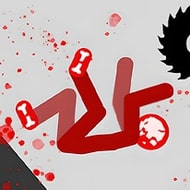
What sells the whole experience is the ragdoll animation on failure. Your red stickman doesn’t just vanish or reset instantly — it flops, tumbles, and folds in ways that are somehow both frustrating and genuinely funny, especially on a launch pad miscalculation that sends it cartwheeling off the edge of the map. It’s the kind of detail players screenshot and share, and it’s part of why the game holds attention even through repeated failures.
The checkpoint marker is the small flag-like indicator you pass mid-stage that saves your progress without ending the run; missing one means a much longer walk back if you die further along. Balancing speed against checkpoint safety is one of the more debated aspects of the game — some players see the checkpoint spacing as fair, others find long gaps between markers punishing given how sudden the traps can be.
Questions Players Ask About Fall Red Stickman
How many stages does Fall Red Stickman have?
The stage count isn’t published anywhere official, but there are enough distinct courses to keep escalating difficulty well past the point where casual players start losing runs regularly to the same handful of obstacle combinations.
Is Fall Red Stickman multiplayer?
No — it’s a single-player game built around solo attempts and replaying stages until you clear them, rather than racing other players in real time.
Why do I keep respawning at the wrong spot?
You’re respawning at your last checkpoint marker, not the start of the stage. If that spot feels wrong, it usually means you passed a checkpoint earlier than you realized during a fast run.
Fall Red Stickman isn’t trying to be more than what it is — a tight, occasionally brutal obstacle course wrapped around a ragdolling stickman and a checkpoint marker system that rewards patience over panic. It’s a short session game that somehow always earns one more attempt.