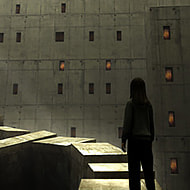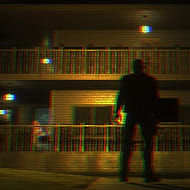








VHOLUME looks, from a screenshot, like a moody walking sim about a lonely brutalist city. It plays like a speedrunning game with a stopwatch built into its bones. That gap between first impression and actual demand is probably the single most common surprise new players report — you expect atmosphere, and you get a movement system that rewards split-second precision.
The Ministry, the Ration Tickets, and Robert
The setup is small on purpose. Robert lives in the derelict capital of Afro-Eurasia under an all-controlling Ministry, and his entire quest is to get his family’s revoked ration tickets restored. There’s no war to stop, no monster to fight — just an administrative system so bloated that simply crossing the city becomes the actual conflict. It’s a clever inversion: most parkour games justify speed with danger, but this one justifies it with bureaucracy you’d rather not sit through.
Checkpoints appear as stiff, official-looking figures scattered through each level, a small visual joke that keeps reminding you whose rules you’re technically still following even as you exploit every shortcut the city offers.
This restraint extends to the writing generally. VHOLUME doesn’t lean on shock or spectacle to sell its dystopia — it’s quieter than that, closer to walking through the remains of a civilization that simply exhausted itself, which is part of why the tone holds together across a full playthrough rather than becoming repetitive.
Momentum as the Only Real Currency
Every mechanic in VHOLUME reports back to the same system: momentum. Momentum is the running total of speed and vertical energy your movement generates, and nearly every advanced technique exists to protect or extend it rather than reset it. Slide out of a fall into a jump and you keep speed a stop-and-start player just threw away. Wall run past an obstacle instead of climbing it and you avoid the deceleration that climbing quietly costs you.
New players consistently make the same two mistakes: stopping to carefully line up jumps instead of committing through them at speed, and treating climbing as a default rather than a last resort. Neither mistake gets punished with an instant death most of the time — it just produces a slower, uglier route than the one that was actually available a second earlier.
There’s also a documented jump-buffer window that experienced players practice against deliberately, timing inputs slightly ahead of a landing rather than reacting to it. It’s not flashy, but it’s one of the clearest markers separating players who are clearing levels from players who are actually racing them.
Racetrack00 and the Demo-Era WR Culture
Long before the full release, the free demo’s opening track, effectively an early version of Racetrack00, became a genuine world-record battleground. Its author time sits around 27 seconds, and players spent months of the pre-launch period pushing runs under 25 seconds, trading world-record videos back and forth. That loop — beat the author time, earn bronze, silver, then gold, then go chase the community record — didn’t start after launch. It was already a culture before the full game even shipped.
Conapt_00 and the Language of the Leaderboards
Once you’re deep enough into VHOLUME to care about times, the leaderboard vocabulary starts doing real work. Individual-level boards like Conapt_00 come with category names that function as rules: whether you’re allowed to carry speed from before the timer starts, and whether routes that briefly leave the intended playspace count at all. Reading those category names is basically reading a map of where the community suspects the exploits live.
Kreedz: The Level Everyone Argues About
Once you reach the B-Side unlocks, the difficulty curve stops being gradual. These are optional, deliberately harder remixes of ideas from the main campaign, and one of them — Kreedz — is close to a running joke in player discussions. Some call it the sharpest test of everything the movement system is capable of. Others call it needlessly punishing, with little of the smart design that defines the rest of the levels. Both opinions show up often enough that it’s genuinely worth forming your own before trusting either side.
What almost nobody disputes is that Kreedz demands a level of consistency the main campaign never asks for. There’s very little room to recover from a mistimed input, and the margin for error on some sections is small enough that a single bad wall run can end a clean run entirely.
Ghosts, Multiplayer, and the Steam Workshop
Three systems push VHOLUME’s replay value well past its roughly 31-level base campaign. Multiplayer lets you run levels together with friends instead of solo. The Ghost system lets you race a recording of any other player’s completed run, watching exactly where they slide rather than just where they end up — which turns learning a route into copying a specific decision rather than guessing. And Steam Workshop support means the community is already building and sharing new levels, effectively making the total level count open-ended rather than fixed.
- Ghosts show route decisions, not just final times, which makes them useful for learning rather than just comparing
- Workshop levels extend content well beyond the 31-level base campaign
- Achievements — 14 in total — track a mix of story progress and movement mastery
The Inconsistencies Players Actually Complain About
It would be dishonest to write about VHOLUME without naming its rough edges. A recurring complaint in player discussions is inconsistent wall-run activation, along with sliding and mantling behavior that doesn’t always trigger the same way twice under seemingly identical inputs. For a movement system this demanding, that inconsistency is a genuine source of frustration, not a minor nitpick — and it’s worth knowing about going in, so you’re not tempted to blame your own execution every time.
An Unexpected Soundtrack Choice
Given the developers’ prior work on a fast, high-energy arena shooter, an ambient soundtrack for a movement-heavy game like this was not the obvious pick. It’s a large part of why the scale of the city lands as hard as it does for players who let it play. It’s also divisive in its own right — a fair number of speedrunners mute it entirely once they shift from exploring to grinding times, finding it more distraction than atmosphere during focused runs.
What First-Time Players Notice
The most commonly reported reaction from new players is that the opening hour undersells the game. Early sections lean into atmosphere and slower exploration, which can read as a walking sim with light platforming. It’s usually only once Racetrack00 or a similarly dense early level shows up that the actual demand of the movement system becomes clear, and the perception flips from moody indie game to genuinely technical parkour title.
What does the B-Side level Kreedz require that the main campaign doesn’t?
Kreedz demands near-constant consistency with very little room to recover from a mistake, unlike most main-campaign levels, which tend to introduce a technique in isolation before combining it with others.
How does the Ghost system work in VHOLUME?
The Ghost system records a completed run and lets you race it directly, showing exactly where that player slid, jumped, or climbed rather than only their final time, which makes it a route-learning tool as much as a competitive one.
Is VHOLUME worth it if I don’t care about speedrunning?
Yes — the base campaign of 31 levels, Robert’s story, and the atmosphere hold up entirely on their own. The speedrunning layer, with medals, Ghosts, and the leaderboard, is an optional system on top rather than a requirement to enjoy the game.
Robert never gets a triumphant ending — he just eventually gets his paperwork sorted — and that smallness is exactly why VHOLUME’s momentum systems feel so oversized by comparison; chasing a gold medal on Racetrack00 or finally clearing Kreedz clean ends up mattering far more than the ration tickets ever did.