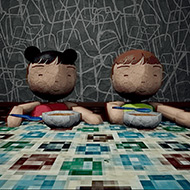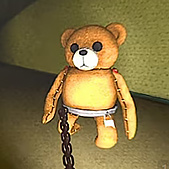








You spawn into the lobby with nothing but a Candle, a Health Pad, and a Magna Doodle, and for about ten seconds the toy-park scenery around you looks almost friendly. Then the lights shift, something scrapes across a corridor two rooms over, and you realize the layout you memorized from your last run doesn’t exist anymore. Wonderland resets its entire park every time you queue, so the confidence you built up last session is worth almost nothing the moment you load in again.
| Genre | Horror / Adventure Escape |
| Players per run | Solo or up to 5 |
| Platforms | Mobile, PC, Console |
| Core loop | Randomized escape with mini-games and monster evasion |
Why Wonderland Refuses to Repeat Itself
Most horror games on this scale still let you learn a fixed route and lean on it forever. Wonderland doesn’t work that way. The park’s layout, the placement of mini-games, which creatures spawn, and what events trigger are all reshuffled per session, so a strategy that saved your group last time might put you directly in a dead end this time. This is the single biggest adjustment new players have to make, and it’s also why veteran players talk about “reading the room” instead of “knowing the map.”
The randomization touches almost every system tied to progression. Sequential puzzles, lever arrays, disorienting mazes, and timed platforming obbies are scattered through the park, and which ones you encounter changes the entire rhythm of a run. A lobby that gets three lever arrays back to back plays completely differently from one that opens with a maze, because the mazes eat far more real time while a creature is actively hunting nearby.
New players consistently misjudge how much time they actually have. The instinct is to sprint toward the first mini-game marker you see, but rushing blind is exactly what gets people caught, since Wonderland doesn’t telegraph danger the way scripted horror experiences do. Slower, more methodical players tend to survive longer here simply because they check corners before committing to a route.
Reading the Threats Around the Park
Wonderland’s roster of hostile toy-like creatures isn’t there just to jumpscare you once and vanish. Each one has a distinct hunting pattern, and figuring those patterns out mid-run is most of what separates a clean escape from a wipe. A fast ambush type tends to wait in narrow corridors and strike the moment your group splits up, which punishes exactly the kind of impatient solo-scouting that beginners default to.
The Mole Chase sequence deserves special mention because it’s one of the few moments in the game with a genuinely different tempo. Once the tunneling threat surfaces near your group, the objective flips from cautious exploration to a full sprint, and players who spent the earlier part of the run conserving stamina for exactly this moment have a real advantage. This is also where the game’s cooperative design shows itself most clearly, since a coordinated group can bait the chase away from a struggling teammate.
- Cautious players who prioritize scouting before engaging tend to trigger fewer surprise encounters
- Speedrun-minded players who rush mini-games often finish faster but die more often on unfamiliar layouts
- Support-focused players who hang back to revive teammates keep squads alive through the Mole Chase far more reliably
Wonder Shop and the Case for Fighting Back
Unlike most Roblox horror titles that limit you to running and hiding, Wonderland gives you actual offensive options through the Wonder Shop. The Hammer and the Minigun are the two headline purchases, bought with Tickets earned from completed runs, and they change the entire calculation of how a chase plays out. The Minigun in particular is explicitly loud enough to draw in extra creatures, which means using it carelessly can turn a manageable one-monster encounter into a full-park emergency.
This tradeoff is one of the more divisive parts of the community’s ongoing conversation about Wonderland. Some players love that combat is even an option, arguing it gives coordinated groups agency instead of pure luck. Others feel the noise penalty on stronger weapons makes them situational at best, since a single Minigun burst can undo a quiet ten-minute run in seconds. Both takes show up constantly in Wonderland discussion threads, and neither side is wrong exactly — it’s a genuine design tension rather than a bug.
Tickets themselves reward more than just kills. Completing mini-games, surviving encounters, and finishing a run all feed into your Ticket total, so a full loadout from the Wonder Shop is realistically achievable within your first handful of sessions if you play consistently rather than chasing one perfect run.
The Wonder Behind Everything
Wonder, the grinning sun mascot that anchors the game’s marketing and opening trailer, isn’t just set dressing. In-game item descriptions tie the Hammer directly back to Wonder as its creator, and the game’s own framing text describes the entire park as “a paradise created by Wonder.” That detail reframes the whole experience once you notice it — you’re not just escaping a haunted playground, you’re escaping something somebody built on purpose.
Early in the game this context is easy to miss because you’re focused entirely on survival. By the time you reach a second or third run and start paying attention to item flavor text between escapes, the intentional design behind Wonderland’s park starts to feel less like random horror-game dressing and more like an actual mystery worth following.
What Beginners Consistently Get Wrong
The most common mistake is treating early mini-games as optional busywork instead of the main source of both progression and in-run currency. Skipping them to explore faster usually backfires, since some of them are your only reliable way out of a monster encounter once one starts. The second mistake is grouping too tightly; bunched-up players make it easy for a single ambush to threaten the whole squad at once, while spread formations give you more warning before a creature closes the distance.
How Difficulty Escalates Through a Run
A Wonderland run doesn’t ramp up evenly. The opening stretch is usually forgiving while your group finds its footing, but pressure spikes hard once you’re deep enough into the park that retreating to the lobby stops being realistic. That’s typically when multiple creature types start overlapping, and it’s also when the Mole Chase or an equivalent high-stakes sequence tends to trigger, forcing a decision between pushing forward or falling back with fewer resources than you’d like.
Frequently Asked Questions
Does the Wonderland map change every single run?
Yes. Locations, mini-game placement, monster spawns, and triggered events are all randomized per session, so no single memorized route will consistently work across multiple runs.
Can you fight back against the monsters in Wonderland instead of just hiding?
Yes, through Wonder Shop purchases like the Hammer and the Minigun, though the Minigun’s noise can attract additional creatures if used without care.
What happens during the Mole Chase sequence?
A tunneling creature begins actively hunting your group, shifting the run from cautious exploration into a sustained sprint that rewards players who conserved stamina beforehand.
Wonderland earns its reputation the hard way, by refusing to let any single run feel like the last one. Between the Wonder Shop’s noisy tradeoffs, the unpredictable Mole Chase, and the quiet implication that Wonder built this entire paradise on purpose, there’s more going on under the surface than a typical toy-park chase game usually bothers with. Once you’ve survived a few resets, Wonderland stops feeling random and starts feeling like a park you’re slowly, carefully learning to read.