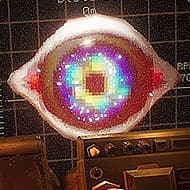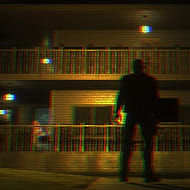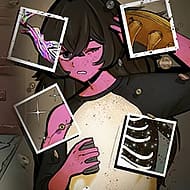








You step into Detective Dick Slater’s beat-up shoes at the Carrion City Police Department, and within minutes you’re staring at crime scene photos of a victim whose skin has been carefully stapled to a wall like some grotesque gallery piece. The Skin Stapler doesn’t ease you into its world, it drops you straight into the investigation and lets the city’s neon-lit decay do the rest of the talking.
| Genre | Retro-styled grindhouse horror adventure |
| Setting | Carrion City, a decaying 1980s urban sprawl |
| Structure | Fourteen short chapters across multiple playable perspectives |
| Style | PSX-inspired low-poly visuals with VHS slasher tone |
Dick Slater and the Case of the Skin Stapler
Most of The Skin Stapler’s investigation chapters put you in the boots of Dick Slater, a jaded veteran detective saddled with rookie partner Robbie Knox and a killer who seems unnervingly interested in him personally. These chapters play closer to a walking simulator than a traditional survival horror game, prioritizing crime scene inspection and dialogue with colorful CCPD coworkers over combat or chase mechanics.
What makes Slater’s sections work is the tonal balance the game strikes. Dark humor punctuates genuinely grim crime scene details, and that whiplash between a wisecrack and a stapled corpse is very much the point rather than a tonal accident. Players who come in expecting a straight slasher game are often surprised by how much of the runtime is spent on investigative dialogue rather than fear-based mechanics.
Hexy, Blair, and the Civilian Perspectives
Beyond Slater’s investigation, The Skin Stapler regularly shifts perspective to civilians living out what might be their final ordinary shift. Hexy works a late-night diner job, serving questionable hot dogs and dealing with weird customers while trying to keep her muscle car, the Jank Wagon, running. Blair works the graveyard shift at a run-down bowling alley, handling small maintenance tasks that feel mundane right up until they don’t.
These civilian chapters change the entire rhythm of the game. Instead of following clues toward a killer, you’re doing small, repetitive job tasks while dread slowly builds in the background, and the sudden appearance of an unsettling stranger who seems too interested in the night’s menu lands harder specifically because the preceding minutes felt so routine.
Structure Across Fourteen Chapters
The full game is built from fourteen short chapters, each one either investigation-focused or survival-focused depending on which character you’re controlling. This structure keeps individual sessions tight, since no single chapter overstays its welcome, but it also means The Skin Stapler asks you to constantly readjust to a new character’s pace and priorities rather than settling into one consistent gameplay loop for the whole runtime.
By the time you reach the later Closing In chapters, the game shifts its pacing again, layering more direct pressure onto whichever character you’re controlling as the investigation and the civilian survival threads start converging. Community discussion around this stretch is some of the most consistent praise the game gets, since the payoff for sitting through the slower early chapters lands noticeably harder here.
Multiple Playable Perspectives as a Storytelling Tool
The Skin Stapler leans on its rotating cast deliberately rather than as a gimmick. Each perspective, whether it’s Slater methodically working a crime scene or a civilian like Scaroline or Layna Lazar just trying to survive a shift, adds context that recontextualizes scenes from other chapters once you’ve seen them all. A detail that seems like set dressing during a civilian chapter can turn out to be a clue Slater is chasing several chapters later, and vice versa.
This layered structure is also where the game draws its most consistent criticism. Players who prefer traditional survival horror sometimes find the investigation chapters too slow, since Slater’s sections lean on dialogue and crime scene inspection rather than tension or combat. It’s a fair critique, and one the developer’s own marketing leans into by describing the experience as prioritizing atmosphere and story over traditional survival mechanics.
Distorted Tapes and Environmental Storytelling
Scattered through Carrion City are distorted audio tapes left behind by the killer, and both the police chapters and the civilian survival chapters use them to steer players toward key locations and reveal fragments of the killer’s mindset. Environmental audio design: these tapes function less like conventional collectibles and more like a second narration track running underneath the main investigation, rewarding players who slow down and actually listen rather than rushing past them.
Community vocabulary around the game has already started forming quickly since launch, with players referring to the tape-hunting side content as “tracking the static,” a term that captures both the literal audio distortion and the unsettling feeling of following a killer’s voice through a decaying city.
The Grindhouse Aesthetic of The Skin Stapler and Why It Works
Chunky low-poly models, pixelated textures, and a scratchy visual filter give The Skin Stapler the exact look of a VHS tape pulled off a shelf of eighties exploitation films, and that aesthetic choice does a lot of heavy lifting for a game that’s fairly light on traditional gameplay depth. The style keeps the tone consistent across every perspective shift, whether you’re examining a crime scene as Slater or nervously restocking hot dogs as Hexy.
Some players find this grindhouse presentation occasionally one-note, arguing the shock value of the gore and the dark humor can wear thin across fourteen chapters in a single sitting. It’s a criticism that shows up alongside the praise fairly often, and both reactions tend to agree on one thing: the PSX-inspired visual style is doing exactly what it set out to do, even for players who wanted more mechanical substance underneath it.
Robbie Knox and the Detective Dynamic
Robbie Knox, Slater’s rookie partner, does more narrative work than his screen time might suggest. Where Slater approaches every crime scene with weary cynicism, Knox reacts the way most people actually would to a body stapled to a wall, and that contrast gives the investigation chapters a second emotional register beyond Slater’s deadpan commentary. Their dynamic also sets up small, specific character beats, like Slater’s visible resentment at being saddled with a partner he didn’t ask for, that pay off once the two are forced to rely on each other later in the case.
Voice acting carries a lot of this weight, since every character in The Skin Stapler is fully voiced rather than relying on text boxes. That choice matters most in the CCPD scenes, where overheard conversations between coworkers flesh out Carrion City as a lived-in place rather than just a backdrop for the murder investigation.
Comparisons to Earlier Grindhouse Horror Games From the Same Team
Players familiar with the studio’s earlier catalog, including Suffer the Night, Terror at Oakheart, and Massacre at the Mirage, tend to notice The Skin Stapler leaning further into dark comedy than those previous releases. Where the earlier games played their scares mostly straight, this one consistently undercuts tension with wisecracks and grimy B-movie humor, which is either the game’s biggest strength or its most divisive choice depending on which forum thread you’re reading.
That shift in tone hasn’t stopped the retro visual identity from carrying over. The same chunky, low-poly look that defined the earlier releases is present throughout Carrion City, giving returning players an immediately familiar aesthetic even as the writing style moves in a noticeably different direction.
LunaArcana and the Rest of Carrion City’s Cast
Beyond Slater, Knox, Hexy, and Blair, characters like LunaArcana and Scaroline round out the rotating perspective structure, each contributing a different flavor of dread to the same overarching case. Some of these chapters lean harder into black comedy, while others sit closer to straight tension, and the variation keeps the fourteen-chapter structure from settling into a predictable rhythm even as the same killer connects every thread.
Players who replay The Skin Stapler after finishing it once tend to notice how deliberately these smaller character chapters seed details that only pay off in Slater’s later investigation scenes, which is part of why community discussion around the game keeps circling back to its structure rather than just its scares.
- How long does a full playthrough of The Skin Stapler take? Most players report finishing the full game in roughly two and a half hours across all fourteen chapters, making it suited to a single extended sitting rather than a game meant to be spread across many sessions.
- Do the different playable characters affect the ending? The civilian and detective threads converge during the later chapters, and the details you notice across Hexy, Blair, and Slater’s separate perspectives inform how the final revelations land, even though the core outcome follows a fixed chapter structure.
- Is The Skin Stapler more about story or combat? The game prioritizes atmosphere, investigation, and survival tension over combat, with most chapters built around exploration, dialogue, and small tasks rather than direct confrontation with the killer.
The Skin Stapler earns its grindhouse label honestly, stitching Dick Slater’s investigation, Hexy’s diner shift, and Blair’s bowling alley night into one uneasy portrait of Carrion City rather than treating them as separate minigames. Whether you’re tracking static off a distorted tape or just trying to survive to closing time, the game keeps circling back to the same stapled, neon-lit nightmare at its center.