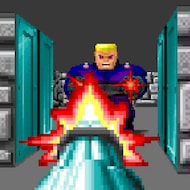








You round a corner in a Castle Wolfenstein corridor and two guards turn toward you a half-second before you’re ready for them — that half-second is the entire game. Wolfenstein 3D puts you in the boots of B.J. Blazkowicz, an escaped operative fighting his way back out through a fortress full of soldiers, dogs, and locked doors, armed with nothing more complicated than a knife and whatever guns you can find or take.
| Genre | First-person shooter |
| Platform | PC, later ported widely |
| Structure | Episodes split into levels, each ending at an elevator or boss fight |
| Core Objective | Clear each level’s threats and reach the exit |
B.J. Blazkowicz’s Starting Arsenal
Every life in Wolfenstein 3D begins the same way: a knife, a pistol, and eight bullets. From there you’re expected to scavenge — pick up a submachine gun off a fallen guard, or find the chain gun hidden somewhere in the level, and suddenly a room full of soldiers stops being a threat and starts being a formality.
The knife matters more than it looks like it should, especially early on when ammo is scarce. Sneaking up behind a guard and dealing with them silently costs nothing and keeps the rest of the level quiet a little longer, whereas the pistol announces your position to anyone nearby the second you fire it.
Health in the game is tracked as a percentage rather than a hit-point pool, starting at 100 and dropping with every hit taken. Losing it all doesn’t end the run outright — you lose a life and restart the level back at square one, knife and pistol only, which makes conserving health early in a level just as important as conserving ammo.
Keys, Push Walls, and Castle Wolfenstein’s Layout
Locked doors throughout Castle Wolfenstein require silver or gold keys, usually guarded by whichever enemy or room presents the most resistance on that level. Finding the right key is often less about searching and more about surviving the room it’s sitting in.
Push walls are the game’s other layer of exploration — sections of wall that look identical to every other wall until you interact with them, revealing secret rooms stocked with treasure, extra ammo, or sometimes an entire hidden area of the level. Community discussion around Wolfenstein 3D still treats secret-hunting as half the appeal, since a level can be technically “cleared” while still hiding rooms most players never find.
By the time you reach a level’s elevator, you’ve usually worked through a maze-like layout of uniform corridors and rooms, all viewed from the same fixed height, which keeps navigation readable even when a level’s design gets genuinely confusing.
Facing Hans Grosse and the Rest of the Cast
Early episodes build toward Hans Grosse, a boss encounter that punishes players still relying on the pistol alone. Later, Dr. Schabbs and his mutant creations shift the threat from straightforward soldiers to something closer to a horror encounter, and the final confrontation puts B.J. Blazkowicz face to face with a robotic suit built around four chain guns.
Regular enemies — soldiers and dogs, mostly — are rendered as flat sprites viewed from a handful of fixed angles rather than fully modeled figures, a technique often called 2.5D. It’s a detail longtime fans still bring up constantly, and one of the more debated aspects of Wolfenstein 3D among players revisiting it today: the flat enemies against fully three-dimensional corridors can look jarring by modern standards, even though it was the whole trick that made the game feel three-dimensional in the first place.
Dogs in particular catch new players off guard, since they move faster and lower than human enemies, making them harder to hit with a rushed pistol shot down a corridor.
Managing Lives and Extra-Life Tokens
- Start each episode with four lives and no way to bank health between deaths
- Find extra-life tokens hidden through levels to keep a buffer against mistakes
- Earn enough score through treasure and kills to gain lives automatically
- Fall back to a knife-and-pistol restart if all lives run out on a level
This lives system is why aggressive players still hunt for treasure even when it isn’t strictly necessary for progress — score-based extra lives turn Wolfenstein 3D’s exploration into a genuine safety net rather than just a completionist habit.
What Beginners Get Wrong in Wolfenstein 3D
New players tend to burn through pistol ammo on enemies that could have been handled with the knife, then find themselves stranded without ammo the moment a real firefight starts. Strafing along corridor walls to avoid a clean line of fire also takes longer to develop than most players expect, since the game’s fixed-height layout makes cover less obvious than it looks.
Rushing toward a level’s elevator the moment it’s found is another common habit that costs players secret rooms and extra-life tokens they’ll want on harder levels later. Slower, more methodical players tend to clear a level with far more resources banked than players racing toward the exit.
Speedrun-focused players approach the game completely differently, deliberately skipping most secrets and combat in favor of the fastest possible route to each elevator — a playstyle that looks almost nothing like a first, cautious playthrough of the same level.
Wolfenstein 3D never asks for much beyond a knife, a pistol, and the nerve to turn a corner not knowing what’s on the other side, and that’s still what makes Castle Wolfenstein worth escaping from one more time. Whether you’re hunting push-wall secrets or sprinting straight for the elevator, the fight always comes back to B.J. Blazkowicz and whatever’s standing between him and the next locked door.