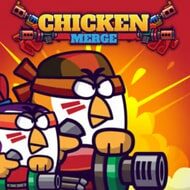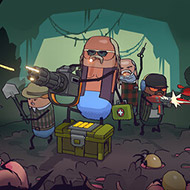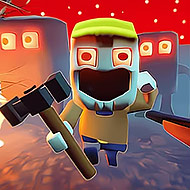








Chicken Merge looks like a cozy farmyard curiosity but plays like a tower defense grind where every wasted second at the merge grid costs you ground at the base. That contrast is exactly why it holds attention longer than its cute art style suggests it should.
| Genre | Merge / Tower Defense |
| Developer | Beedo Games |
| Core objective | Merge chickens into stronger guardians to defend the base |
| Platform | Browser and mobile |
Merging Guardian Chickens in Chicken Merge
The core loop is simple to describe and harder to execute well under pressure: drag two identical chickens together to fuse them into a stronger guardian, then drag that guardian onto the defense lines to hold off incoming enemies. What separates strong runs from weak ones isn’t understanding the merge itself, it’s timing when to merge versus when to deploy immediately with what you already have.
Beginners often merge everything on sight, chasing the satisfaction of a higher-tier chicken, and end up with an empty defense line right as a wave hits.
From Chick to Guardian: How Tiers Work
Every merge produces a chicken one tier higher than the pair that created it — a term the community uses to describe a chicken’s strength level, since two tier-one birds always become a single tier-two bird, and so on up the chain. Higher-tier guardians hit harder and survive longer at the defense lines, but they also take longer to build, which is the trade-off the whole game is balanced around.
Defense Lines and Positioning
Placing a guardian on the defense lines isn’t just about strength, it’s about where the current wave is concentrated. Early in the game, enemies approach from a single direction, so positioning barely matters. Once mixed waves start arriving from multiple angles, spreading guardians thin across the lines usually fails faster than committing your strongest chickens to the side taking the most pressure.
Players who ignore positioning and just place merged chickens wherever space opens up tend to lose the base earlier than their guardian strength would otherwise predict.
Managing the Coop Under Pressure
The coop, where new chicks continuously appear for merging, never stops producing, which means the real skill in Chicken Merge is managing an overflowing grid without losing track of which chickens are ready to merge and which are one step behind. Letting the coop fill up completely locks you out of new merges at the worst possible moment, usually right as a tougher wave spawns.
Enemy Hordes and Escalating Waves
Waves don’t scale evenly. Early hordes are slow and predictable, giving players time to build a merge chain before engaging. By the time stronger enemy types appear, usually once the defense lines have taken a few hits, players who haven’t built at least a couple of higher-tier guardians start losing ground fast, since low-tier chickens simply can’t keep pace with enemy health scaling.
This is a common point of frustration in player discussions — the jump in enemy strength can feel sudden rather than gradual, and it’s one of the more divisive aspects of the game’s pacing.
Upgrades, Weapons, and Long-Term Power
Beyond merging, players unlock upgrades and weapons that boost guardian stats across the board rather than just one chicken at a time. These upgrades matter most for players planning to push past the point where merging alone can keep up with enemy hordes, since a maxed-out low-tier guardian can sometimes outperform an unupgraded higher-tier one.
Common Early Mistakes in Chicken Merge
New players consistently make three mistakes: merging too aggressively and leaving the defense lines empty, ignoring the coop until it overflows, and placing guardians without regard for which side of the base is under pressure. Correcting even one of these noticeably extends how long a run survives.
Divisive Moments Players Debate in Chicken Merge
Beyond the wave-scaling frustration, players are split on whether the merge grid is too small for how fast the coop fills up in later stages. Some see it as the core tension the game is built around; others see it as an artificial difficulty spike that punishes players for playing the merge system as intended. Neither view has fully won out in community discussions, and that disagreement is part of what keeps the game’s strategy conversations active.
Chicken Merge succeeds because the cute, low-stakes presentation hides a genuinely demanding resource-management problem, and once you’re juggling an overflowing coop against a horde bearing down on the defense lines, it stops feeling like a farmyard game entirely.