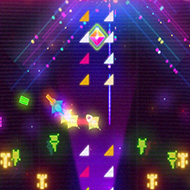







Death Ray Manta looks like it should be a slow, moody shooter built around one massive laser-firing ray, but the arena a player lands in plays nothing like that. Instead of a boss encounter, the game drops a ship into an open arena and throws wave after wave of small, fast enemies at it from every side, and that gap between name and reality catches first-time players off guard.
| Genre | Top-down arena shooter |
| Setting | Open space arena |
| Camera | Fixed overhead view |
| Objective | Survive escalating waves and clear each arena |
Movement and Dodging in the Death Ray Manta Arena
The ship turns and strafes quickly, and that speed matters because incoming fire rarely gives more than a second of warning. Standing still is usually a losing move, since enemies spawn from multiple edges rather than one.
Early waves are forgiving enough that sloppy movement still works, which is why players get caught off guard once the pace picks up. The arena does not visibly change shape, but the density of incoming shots does.
Community discussion around arena shooters like this centers on one complaint: it is hard to tell, mid-wave, which shots will hit and which pass by harmlessly. That ambiguity makes Death Ray Manta feel tenser than its bright presentation suggests.
Enemy Waves and Power-Ups in Death Ray Manta
Enemies arrive in clusters rather than one at a time, and later waves mix faster targets in with slower ones that soak up extra shots.
The game drops occasional power-ups mid-wave, and grabbing one on reflex is not always right if it means drifting into a crowded lane. Reflex players grab everything on sight; cautious ones wait for a clear path.
- Opening waves favor slow, predictable patterns
- Mid-run waves introduce faster enemies in clusters
- Later waves combine both with tighter timing between spawns
Arena Pressure Once a Run Runs Long
Once a run stretches past its opening minute, the arena feels smaller though the boundaries never move. That sensation comes from the sheer number of active shots on screen.
Patient players fare better here, hanging near the arena’s open middle instead of getting cornered. Speed-focused players who cleared early waves on reflex often struggle once clusters overlap.
- Why does Death Ray Manta feel harder than its bright visuals suggest? The colorful presentation hides a fast arena shooter, and the gap between how calm it looks and how quickly waves escalate overwhelms new players fast.
- Is there a safe way to grab power-ups mid-wave? Only when the firing lane toward the pickup is clear; grabbing on reflex during a crowded wave usually trades one problem for a worse one.
- Do the arena boundaries actually shrink during a run? No, they stay fixed, but heavy enemy fire late in a run makes the same space feel far more cramped.
Death Ray Manta rewards players who stop expecting a slow boss fight and treat every wave as its own short decision. Ships that survive longest weave constantly between clusters instead of trying to out-shoot them head-on.