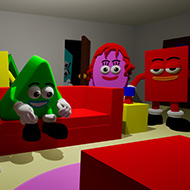








Denshattack! puts you at the front of a train barreling down a track that never holds still, and the entire challenge comes down to reading the rail ahead before it curves, splits, or throws an obstacle into your path. It’s less about raw speed and more about reacting a half second before a straightforward run turns into a scramble.
| Genre | Arcade train racer |
| Perspective | Forward-facing rail view |
| Core Focus | Track reading and lane switching |
| Session Length | Short, replayable runs |
Reading the Track Ahead in Denshattack!
Lane switching is the entire toolkit in Denshattack!, and the difference between a clean run and an early collision usually comes down to committing to a lane before the obstacle is already on top of you. Beginners tend to react to obstacles only once they’re clearly visible, which works at low speed and stops working once the pace picks up.
Players who scan a full screen-length ahead instead of focusing directly on the train itself tend to switch lanes earlier and more calmly, avoiding the panicked last-second dodges that end most early runs. Community chatter around Denshattack! keeps circling back to this same point: the train itself is rarely the thing that causes a crash, the missed read on the track ahead is.
- Watch the far edge of the visible track, not just the space directly ahead
- Commit to a lane switch early rather than waiting for a clear gap
- Expect the pace to increase gradually rather than in sudden jumps
Why Denshattack! Gets Harder Without Warning
The track in Denshattack! doesn’t announce a difficulty increase directly; speed simply climbs the longer a run continues, and obstacles that were manageable early start requiring faster reactions later. That gradual escalation is one of the more debated aspects of the game among players, since it can feel unfair to newer players who don’t expect the ramp.
What is the fastest way to improve at Denshattack!? Most regulars agree that watching ahead of the train rather than at it is the single habit that separates long runs from short ones, more than any specific lane pattern. Is the difficulty curve fair? Opinions split here, with some players enjoying the escalating pressure and others feeling it ramps too quickly for a genre built around quick, replayable sessions.
Denshattack! stays approachable precisely because a bad run costs almost nothing, and the same instinct that improves one attempt, watching further down the track instead of reacting late, carries directly into the next.