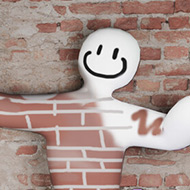








Meccha Chameleon looks like a party game with no depth and plays like a game that quietly rewards hours of attention. The white character model that greets you at the start of every round is not a cosmetic choice — it is the entire design philosophy stated in visual form. You are nothing until you decide what to become, and what you become is limited only by how well you can read the room around you and translate that reading into paint.
The Prep Phase and the Decisions That Decide the Round
Preparation time in Meccha Chameleon is somewhere around 55 seconds, and how you spend it determines your entire round. There is a common and understandable beginner mistake of spending the first half wandering the map looking for the best hiding spot. By the time many new players commit to a location, they have twenty seconds left, which is not enough time to paint convincingly. The community phrase for this is “still half-painted when the hunt begins,” and it is one of the most reliable ways to get tagged in the first ten seconds of the hide phase.
The correct rhythm is to lock your hiding zone in the first third of prep time, then immediately open the Meccha Paint interface and start sampling. The eyedropper — opened with F by default — lets you click directly on the environment to pull exact colours. Sample from the specific surface you are hiding against, not from a nearby surface that looks similar. A kitchen counter and the wall above it may look like the same off-white to a human eye, but on your character model the difference becomes visible under the level lighting.
Players who have been in the game for multiple sessions develop what some call a prep budget — a mental allocation of how much time goes to exploration, painting, and pose selection. Roughly: explore fast and commit early, paint through the middle of prep, and spend the final ten seconds adjusting your pose and checking your outline. The last step is one many players skip entirely, and skipping it is why convincing colour matches still get tagged because the player’s arm crosses a surface edge in a way that reads immediately as wrong.
Meccha Paint Beyond the Basics
Most players who pick up Meccha Chameleon treat the paint tool as a colour picker. It is considerably more than that. The full Meccha Paint interface includes a colour palette, HSV sliders for fine adjustment, an eyedropper for environment sampling, brush size and pattern controls, and roughness and metallic sliders that change how the painted surface interacts with level lighting. The roughness slider in particular is something many players do not notice until they have been playing for several sessions.
The practical consequence is this: if you paint yourself with a perfect colour match on a roughness setting that does not match the wall behind you, your body will catch light differently from the surrounding surface. Against a matte plaster wall, a glossy finish on your character reads as a suspicious sheen. Against a polished floor section, a matte finish on your character creates a flat patch that the Seeker’s eye catches precisely because it does not reflect the way everything around it does. Matching finish as well as colour is the technique that separates experienced Hiders from people who just colour-match.
The pattern tools add another layer that few players explore in early sessions. Checkerboard floors, wallpaper lines, tiled surfaces, and repeating textures can all be approximated with the brush pattern options, breaking up the outline of your character model in ways that a flat colour block cannot. A checkerboard character standing on a checkerboard floor becomes genuinely difficult to spot even at close range, because the Seeker’s eye reads pattern continuity rather than individual object edges. Players in the community who specialise in pattern matching tend to post results that look like optical illusions in the post-round screen.
Pose Selection and Silhouette Control
The pose menu is the second most overlooked system in Meccha Chameleon after the roughness slider. Players have access to several poses — stand, crouch, curl, and wall-flat among the most used — each producing a different silhouette and a different relationship to the environment geometry. The instinct for new players is to crouch because crouching feels like hiding. Crouch is a reasonable default but produces a recognisable rounded shape that Seekers learn to identify quickly.
Wall-flat is the pose that changes how experienced players think about hiding. Pressed against a vertical surface, your character’s depth is minimised, which means the outline is smaller and easier to justify against a flat background. The tradeoff is that it requires planning: you need to be near a wall when pose-lock time arrives, which means choosing your spot with wall proximity in mind during the first third of prep. Players who pick a corner cluster and then try to apply wall-flat often find the pose does not fit the geometry they chose.
Curl is most effective in tight spaces and on floors, where the round shape can read as a dropped object or furniture element rather than a character outline. The specific zones where curl works best — corner floor spaces, bases of large furniture, spots where objects cluster near walls — are part of the map knowledge that experienced players accumulate across sessions. Knowing that a specific corner in a specific level allows a curl with decent colour coverage is the kind of information that gets shared in Discord servers and streaming chats after someone pulls off an unusually long survival.
What Seekers Learn Over Time
Seeker skill in Meccha Chameleon develops along a specific axis. Early Seekers look for wrong colours. Intermediate Seekers start checking shapes. Experienced Seekers read the geometry of the level and ask which positions would allow a convincing hide, then check those positions first. The mental model shifts from “find something that looks wrong” to “find something that someone would have tried to make look right.”
This is the behaviour behind what the community calls habit-reading — the observation that human beings return to comfortable hiding strategies. A player who successfully hid behind the kitchen counter in round one will frequently return there in round two. A player who favours high positions will pick from the same cluster of elevated spots across sessions. Seekers who track individual player tendencies across a session, particularly in a private lobby with a fixed group, develop a read that functions more like psychology than perception.
The Missed Spot Ranking at the end of each round reinforces this. Seeing exactly where each Hider was positioned, and seeing which positions came closest to surviving the full timer, creates a shared map of viable spots that updates the entire lobby’s knowledge simultaneously. Some players find this too generous — great hiding spots get burned after one successful use because everyone can see them. Others argue it keeps the game from stagnating around the same three corners every session. The toggle that lets hosts hide the Missed Spot Ranking from Seekers is the current community compromise, though it does not stop Hiders from seeing their own result.
Double Mode and What It Actually Teaches
Double mode is the most instructive game mode in Meccha Chameleon for groups that include players at different experience levels. Every participant hides in the first half of the round and seeks in the second, which means no one spends an entire session locked into one role. Players who have only ever Seeked quickly discover how much harder painting under prep time pressure is than it appears from the outside. Players who have only ever hidden discover how differently the map reads when you are looking for wrong shapes instead of hiding from someone looking for them.
The asymmetry it reveals is useful. Most new players assume that the hard role is the Hider — you have to create a convincing disguise from nothing in under a minute. Most experienced players eventually conclude that high-level Seeking is the harder skill, because a genuinely committed Hider with good paint, good pose, and a well-chosen spot gives the Seeker very little information to work with. Seeking at that level requires accumulated map knowledge, reading of player habits, and patience that most casual sessions do not require.
Streamers and content creators have driven a significant portion of Meccha Chameleon’s early momentum, and Double mode creates the most naturally entertaining rounds for viewer participation lobbies — everyone gets to be the person who either pulled off or failed the disguise, which generates more varied moments than a session where the same two players Seek every round.
Honest Assessment of Where the Game Is Right Now
Meccha Chameleon arrived on Steam in June 2026 with approximately 1,200 reviews and a Mostly Positive rating within its first few days, which reflects genuine enthusiasm alongside some recognised rough edges. The game is from a solo developer and carries the signatures of that context: a lobby system that requires all players to be on the same network quality, some inconsistency in how poses interact with geometry across different maps, and a moderation situation on public servers that the community has flagged as an active issue.
The Workshop map pipeline has moved quickly. Custom stages began appearing within days of launch, and the most-subscribed maps were attracting hundreds of workshop ratings within the first week. The game’s modding tools are functional enough that community stages can offer meaningfully different hiding dynamics from the official maps — different texture palettes, different geometry complexity, different lighting conditions that change how effectively the eyedropper samples translate to convincing disguises.
The question the community is watching is whether the player count holds through the post-launch discount window. The game sold over a million copies within four days of release, a figure that reflects viral momentum rather than a large pre-existing audience. The staying power of Meccha Chameleon depends on whether the Workshop pipeline, mode variety, and social dynamics of a good lobby are enough to keep groups returning after the novelty of the core mechanic settles in.
Is Meccha Chameleon similar to Prop Hunt?
Both games involve hiding from Seekers in a multiplayer environment, but the mechanics are meaningfully different. Prop Hunt assigns Hiders a preset object model with a fixed silhouette. Meccha Chameleon keeps your character as a humanoid figure and requires you to paint it manually using the Meccha Paint system. The freehand element means every disguise is unique and the quality varies entirely based on how well the Hider executes colour matching, finish adjustment, and pose selection in the available prep time.
How does the Increasing Oni mode work?
Increasing Oni starts with a standard Seeker-versus-Hider setup, but every Hider who gets tagged switches to the Seeker team. As the round progresses, the Seeker group gains numbers while the surviving Hiders face an increasingly difficult hunt. The HUD displays a row of Hider icons that turn red as players are found, so everyone can track how many Hiders remain. The final survivors in a full-lobby Increasing Oni round typically face a Seeker team of eight or nine players who already know the map from having hidden in it themselves.
What is the most common mistake beginners make as a Hider?
Spending too long exploring the map during prep time and arriving at a hiding spot with too little time to paint properly. A half-painted character is one of the most visible things in the level — it stands out against any background because no surface in the environment is partially coloured. The fix is to commit to a zone early, use the eyedropper immediately on arrival, and spend the final seconds on pose and outline rather than still looking for a better spot that prep time no longer allows you to reach.
After enough sessions with Meccha Chameleon, the round structure becomes something you process differently than you did on your first lobby. You stop seeing a room and start seeing a prep budget — which surfaces have eyedropper-friendly textures, which corners allow a wall-flat that does not cross a surface edge, which lighting condition makes roughness matching critical. The moment that shift happens is difficult to locate precisely, but it tends to arrive around the same time you first survive an Increasing Oni round to the final thirty seconds while a full converted Seeker team searches the level for you specifically. The game earns that moment.